




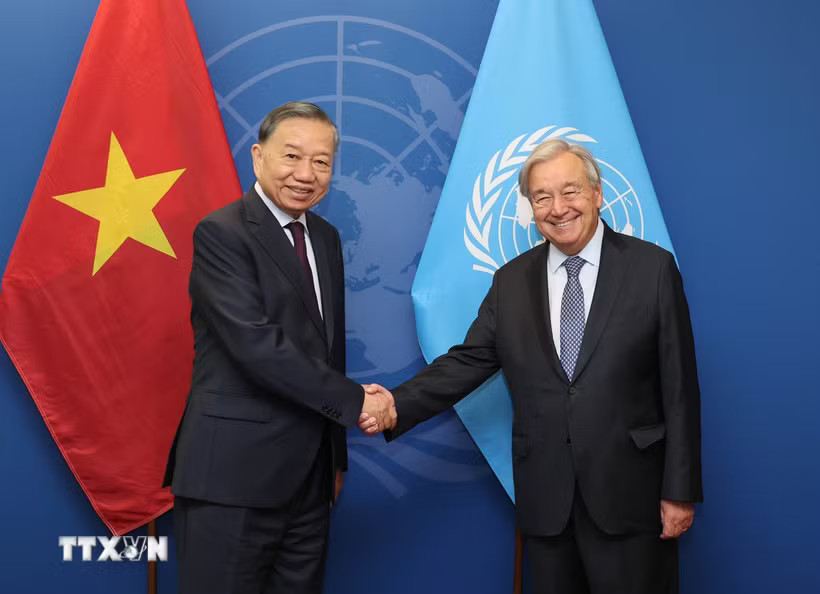
General Secretary and President of Viet Nam To Lam (left) meets with United Nations Secretary-General António Guterres (right). (Photo: VNA)
For Vietnam, international integration is not merely a means of expanding development opportunities, mobilising external resources and improving people’s living standards. It is also a process of affirming the country’s standing and responsibilities as an independent and self-reliant nation, actively contributing to the international community’s shared efforts.
A major milestone in this process came on 29 January 2026, when Vietnam and the European Union (EU) officially upgraded their relationship to a Comprehensive Strategic Partnership, marking a significant step forward after 35 years of diplomatic relations. This development reflects the growing depth of bilateral ties while opening up new prospects for cooperation between a dynamic, developing Vietnam and an EU that attaches importance to multilateralism, international law, open trade and sustainable development.
From Expanding Diplomatic Relations to Enhancing Vietnam’s International Standing
After decades of reform and integration, Vietnam has established an extensive network of diplomatic relations, maintaining diplomatic ties with 194 countries while continually deepening cooperation with key partners around the world.
From an economy that was once isolated, Vietnam has become an increasingly integrated part of the global economy. Its participation in numerous free trade agreements, including new-generation trade pacts, together with its active engagement in regional and international cooperation mechanisms, has created additional momentum for growth, trade and investment.
These achievements have been built on Vietnam’s foreign policy of independence and self-reliance, peace, friendship, cooperation and development, the diversification and multilateralisation of external relations, and proactive and active international integration. Vietnam consistently pursues the goal of being a friend, a reliable partner and a responsible member of the international community.
Guided by these principles, Vietnam has proactively expanded cooperation, maintained balanced relations with its partners and aligned national interests with the common interests of the region and the wider world.
For Vietnam, independence and self-reliance do not mean isolation, just as international integration does not imply dependence. On the contrary, a more resilient economy, stronger development resources and enhanced scientific and technological capabilities will enable the country to participate more substantively in addressing international challenges.
Conversely, a peaceful and stable international environment, supported by a diverse network of cooperative relationships, provides an essential foundation for sustainable domestic development. The close connection between national development and international responsibility has therefore become a defining feature of Vietnam’s foreign policy approach.
The effectiveness of diplomatic relations is measured not only by the number of agreements signed or high-level visits conducted, but also by the ability to translate commitments into tangible results. These include investment capital and technology for development, employment opportunities, improved human resource quality, better environmental protection and stronger capacity to withstand external shocks.
Vietnam–EU Relations: Building a Long-Term Strategic Partnership
The elevation of Vietnam–EU relations to a Comprehensive Strategic Partnership opens a new chapter in bilateral cooperation, bringing the relationship to a level more commensurate with the achievements of the past 35 years and its future potential.
Relations have evolved beyond traditional political dialogue and development cooperation, progressively expanding into trade, investment, the green and digital transitions, education, science and technology, security, and global affairs.
In the economic sphere, the EU–Vietnam Free Trade Agreement (EVFTA) remains a key pillar of bilateral relations. Its effective implementation helps expand market access, boost trade and investment, and encourage Vietnamese businesses to strengthen their competitiveness, improve product quality and meet international standards.
For European businesses, Vietnam offers considerable potential as a partner in Asia’s production networks and supply chains. Industry, infrastructure, energy and services present significant opportunities for cooperation, particularly as economies seek to diversify supply chains and enhance resilience against global uncertainties.
However, the prospects for Vietnam–EU cooperation extend well beyond trade and investment. The green transition, clean energy, resource efficiency and innovation are also areas in which both sides share substantial interests.
The Just Energy Transition Partnership (JETP), together with cooperation programmes on climate and energy, provides a framework for Vietnam to mobilise financial resources, technology and international expertise to support its energy transition and advance its sustainable development objectives.
To fully realise this potential, the Comprehensive Strategic Partnership needs to be translated into programmes with clearly defined objectives, effective implementation mechanisms and tangible benefits for people and businesses on both sides.
Vietnam has substantial needs in advanced technologies, high-quality infrastructure, workforce training and modern governance. The EU, meanwhile, possesses considerable strengths in science and technology, green industries and sustainable development solutions. This complementarity provides a solid basis for mutually beneficial cooperation while contributing to the transformation of the global economy.
A mature partnership must also provide space for frank dialogue on differences. Vietnam and the EU can continue to strengthen constructive exchanges, identify common ground and pursue shared long-term development goals on the basis of mutual respect and international law.
Proactive Engagement and Contributions to Multilateral Forums
Alongside the expansion of bilateral relations, Vietnam increasingly views multilateral diplomacy as an important instrument for safeguarding national interests, addressing global challenges and reinforcing a peaceful international environment grounded in international law.
Vietnam has undertaken numerous important responsibilities within international organisations, including two terms as a non-permanent member of the United Nations Security Council, in 2008–2009 and 2020–2021. During these terms, Vietnam actively promoted dialogue, upheld the UN Charter and supported peaceful solutions to international issues.
At the regional level, Vietnam continues to contribute to ASEAN unity and centrality while supporting a peaceful, open and inclusive Asia-Pacific and Indo-Pacific regional architecture. Cooperation between ASEAN and the EU also offers further opportunities for Vietnam to strengthen its role as a bridge between the two regions.
The Joint Statement of 29 January 2026 on the elevation of Vietnam–EU relations to a Comprehensive Strategic Partnership emphasises the importance of multilateral consultations, multilateralism and cooperation in addressing climate change, ensuring energy security and mitigating supply chain risks.
For Vietnam, multilateralism is not merely a principle of foreign policy; it is also a practical means for countries to develop common rules, reduce the risk of conflict and address cross-border challenges while respecting independence, sovereignty and international law.
Vietnam’s transition from participation to more proactive contributions is also evident in its involvement in United Nations peacekeeping operations. Since 2014, Vietnamese military and police personnel have served in missions in South Sudan, the Central African Republic and the Abyei area, deploying Level-2 field hospitals, engineering units and staff officers.
Beyond their professional duties, Vietnamese personnel have provided medical assistance, supported infrastructure development, helped protect civilians and contributed to improving living conditions in host communities. The participation of Vietnamese female officers has also helped advance the UN Women, Peace and Security agenda.
Having experienced the devastating consequences of war, Vietnam understands the value of peace and the importance of preventing conflict. Its participation in peacekeeping operations therefore reflects not only its international responsibilities but also its conviction that safeguarding national interests is closely linked to maintaining international peace and security.
A Trusted Partner for a Sustainable Future
The elevation of Vietnam–EU relations to a Comprehensive Strategic Partnership marks an important milestone in Vietnam’s international integration. Beyond creating new momentum for bilateral cooperation, this development underscores the growing importance of trust, mutual respect and shared interests in international relations.
In an increasingly uncertain world, Vietnam remains committed to pursuing development on the foundations of independence, self-reliance, diversified external relations and deeper international integration. A strong and sustainably developing Vietnam will have greater resources to improve people’s lives, safeguard national interests and contribute more effectively to the international community’s collective efforts.
From expanding diplomatic relations to participating in efforts to address global challenges, Vietnam is steadily strengthening its image as a trusted, proactive and responsible partner — ready to work with countries and international organisations to build a peaceful, secure and sustainable future.
PROMOTED

The Austrian capital, Vienna, hosted the international exhibition "Ostropharm" for medical and pharmaceutical services and pharmaceutical products, and its works lasted for 3 days.
WAJ- Grand Master Kamal Samer - Olympic medal returned to pay "Thank You"
- Headwing Economics: IAED Launches International Dialogue on Ethical Economic Development
- Austria news - Usama Nosshy channel covers Asean's 55th anniversary celebrations at the United Nations in Vienna
- How to make the most of the IPI World Congress



MOST VIEWED


The two Kings Philippe and Van der Bellen havedifferent backgrounds, one is of royal origin, and the other is a child of a refugee family (once of noble origin) but now, in the eyes of the European public, both of them are giving off a sense of courtesy, virtue and erudition.
WAJ
With the attendance of many international figures, the 80th anniversary of the end of World War II was celebrated at the United Nations headquarters.
Journalist Usama Soliman



Comment