





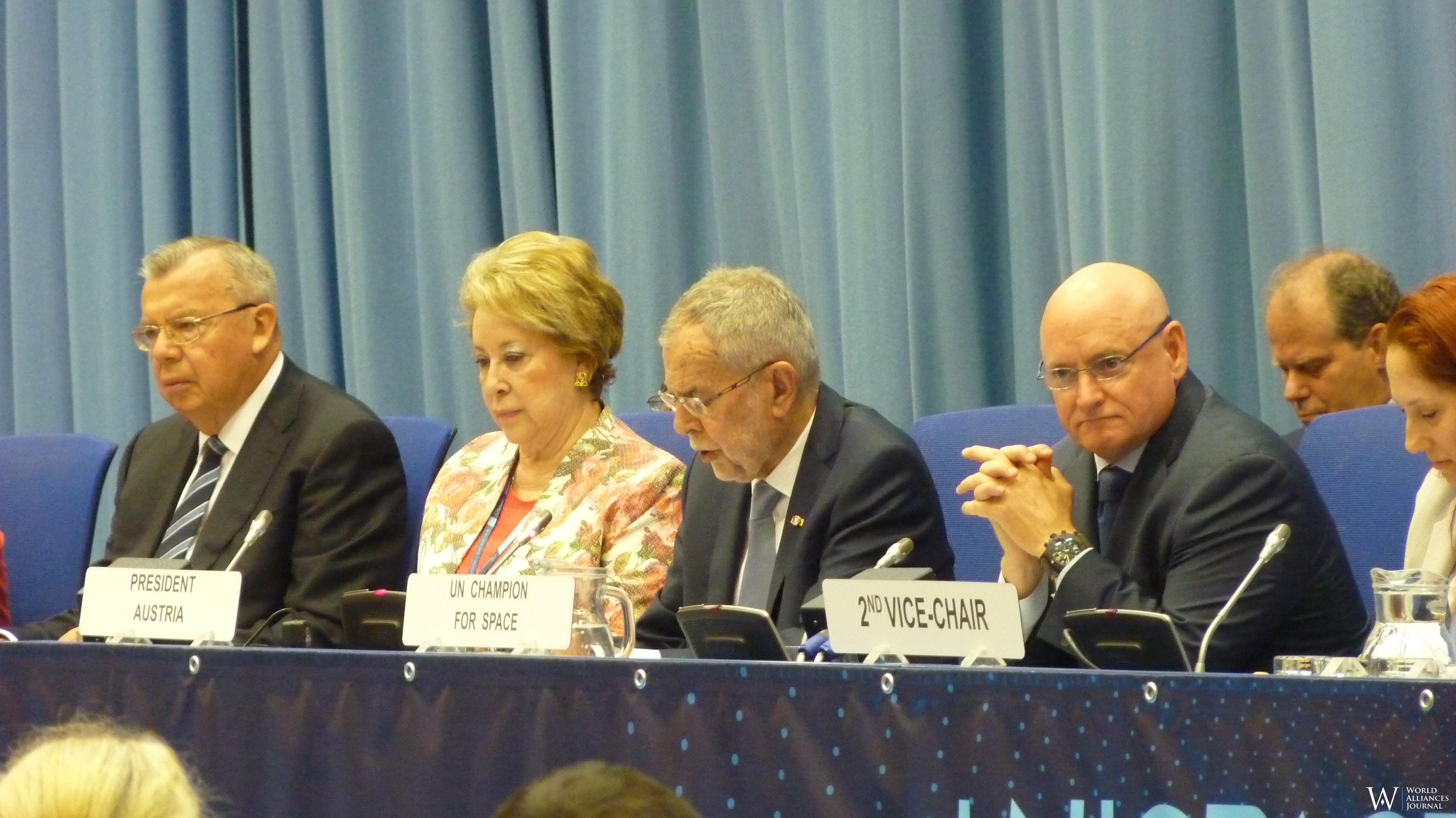
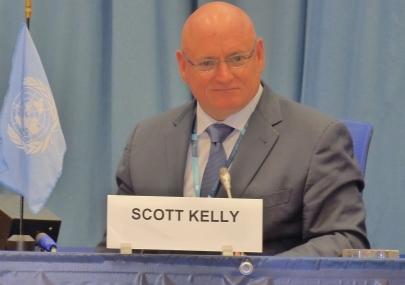
Astronaut Scott Kelly, NASA, USA (right), at the UNISPACE+50 Conference, 18–23 June 2018 – UN Vienna. (Photo: Platz/WAJ)
Astronaut Scott Kelly was born on February 21, 1964, in Orange, New Jersey, USA. He is of Irish descent. Kelly was appointed the United Nations Aerospace Champion (UNOOSA) (term 2016-2018). During his career, he has received many prestigious awards, medals, and honors from the US, Russia, and the United Nations. He is the commander of the International Space Station (ISS) and also the record holder for the total number of days lived in space, 340 days.
He broke his own record, which was previously 215 days (October 2015) (However, the world record still belongs to Russian astronaut Valery Polyakov, who spent 437 days on
the Mir space station in the mid-1990s). Scott Kelly and his twin brother, former astronaut
Mark Kelly, are jointly participating in the “One Year in Space” Project, part of the Human Research Program of the US Aeronautics and Space Administration (NASA).
This work helps scientists study the effects of long-day space flights on the human body and in-depth research on Kelly’s health and psychological status compared to his twin brother living on Earth. These research results are likely to be used by NASA to send humans to Mars in the future. This project started in 2015 and lasted for 3 years.
According to Christian Science Monito: “President Obama’s administration has asked NASA to prepare a plan to send humans to the Moon by 2025 and to Mars orbit by the mid- 2030s”. This project carries the mission of paving the way for humanity to find a new planet in the future. I was fortunate enough to have the opportunity to interview that one and only great man.
His charisma is noticeably bright and brilliant, but still very close and somehow witty. It seemed like he wanted to hide his face from the camera, so the photographers had to constantly adjust their cameras. Occasionally, the conference filled with laughter because of his jokes, while his face still remained “sober”. He is able to make the audience laugh both face-toface and from footage filmed in a zero-gravity environment. Kelly has certainly brought the public and the press - media closer to space science than ever before.
The man “with space genes” was originally a boy who was “very bad at science” and was a “daydreamer”. He once shared with Time Magazine that: when he was a child, he did not like science and many other subjects, and almost could not graduate from high school. He was a “daydreamer” and could barely concentrate on what the teachers at school were teaching, even though he really wanted to.
But everything changed when Kelly accidentally read the book “The Right Stuff” by author Tom Wolfe. It’s a classic about the lives of the first Americans to explore space. He was incredibly inspired by that book and decided to become a pilot and an astronaut. That determination motivated Kelly to study harder, especially science and math. Every day he practiced them like playing a sport and competing with himself.
After a while, his friends and Kelly himself were surprised that “from being a bad student, he started getting straight A’s in engineering”. When he entered college, Kelly became
even more determined, eventually obtaining an engineering degree to enter a career as a test pilot and astronaut. Therefore, Kelly has repeatedly shared with the public that: “Anyone can learn science as long as they are willing to do it”.
From his practical experience, he advised parents: “If a child ever shows a “spark” in anything, we need to help fuel that fire”. Parents should be the ones who create conditions and opportunities for their children to reach the fields they love. Let them get a chance to meet and learn from professors, and experts and listen to their stories and
career paths to guide, motivate, and inspire them. After living in space for nearly a year, he returned and traveled around the world to share his experiences and inspire the public.
He once shared with Time Magazine: “One of the things I heard from the audience that surprised me the most was that they believed science was too difficult, too complicated, for the average person to understand”. As a United Nations aerospace champion, through his great life and career, Kelly is undoubtedly inspirational and gradually conquering the public’s interest in the field of space science.
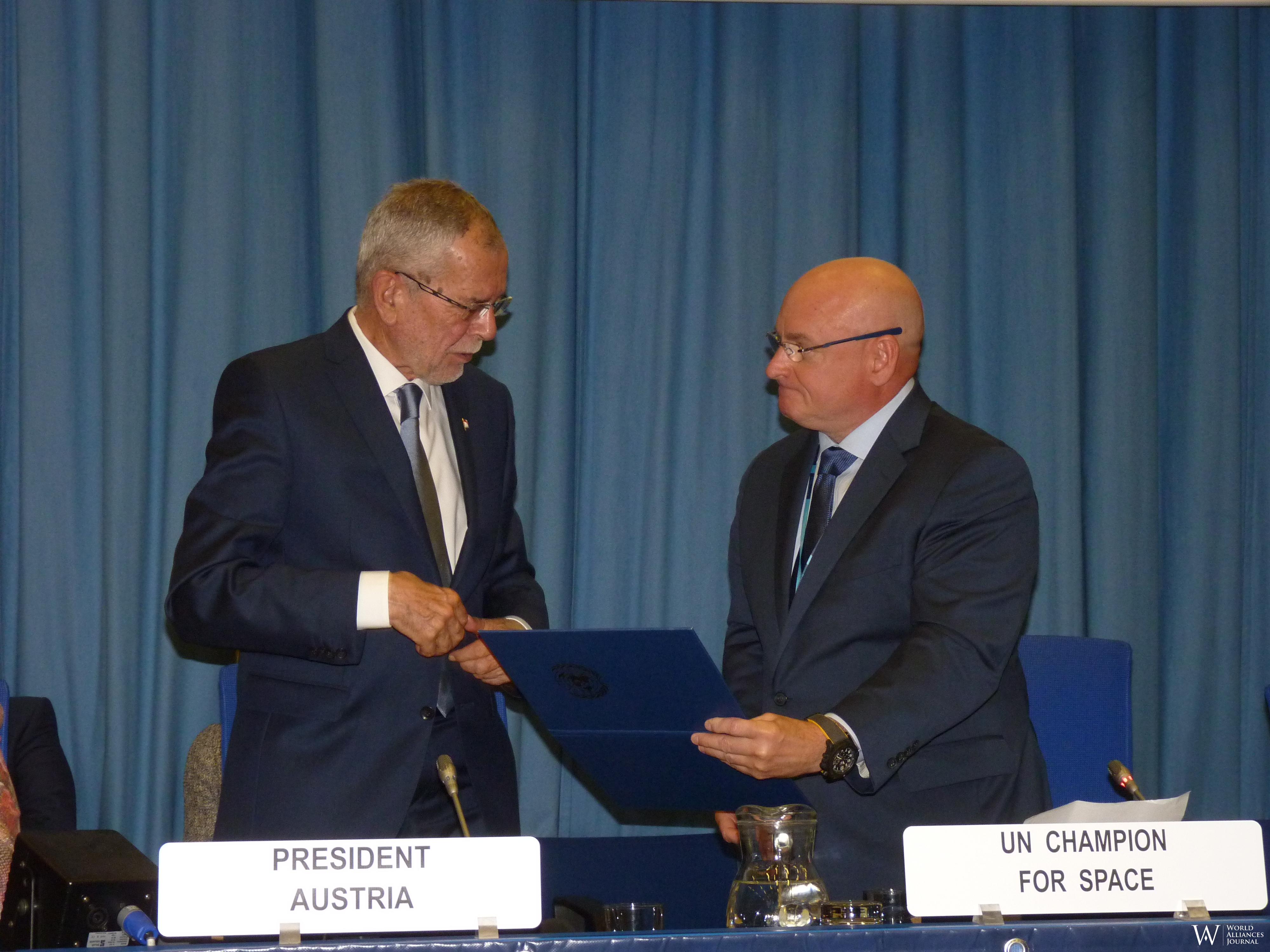
Astronaut Scott Kelly (left) presented to Austrian President Van Der Bellen (right) a special set of stamps issued by the US National Postal Service on the occasion of UNISPACE+50. (Photo: Platz/WAJ)
We were also genuinely impressed with his speech at the United Nations Global Space Summit (UNISPACE+50) (June 19, 2018), on the occasion of the 50th Anniversary of the United Nations Conference on the Exploration and Peaceful Use of Outer Space: “To succeed in life, we need to embrace challenges. Understand what you can and cannot
control in life and focus on what you can get a grip on”.
I became curious about the universe myself - a place that still holds many mysteries for mankind. With his great sense of humor and friendliness, the “space gene carrier” esponded to my interview as follows:
What was your most memorable impression when traveling into space?
Scott Kelly: It’s just extremely difficult, complicated, and challenging, that’s what makes it.
Would you mind sharing a few projects of yours in the near future?
Scott Kelly: My project, I have some ideas indeed. I have presented a lot about them in public. I am currently working with several companies. I have also written in a few books, but other than that I have no plans at all. I am the United Nations aerospace champion, and I am sincerely proud of that.
Where do you think the aerospace industry is going in the next 20 years?
Scott Kelly: In 20 years, I truly can’t imagine what it will be like, but what I do know is that it can be whatever it wants to be, I hope so. Perhaps, in this 21st century, Scott Kelly is one of the lucky ones chosen to “dedicate” to humanity’s space science mission. But it was his effort and determination that created such luck.
Kelly is the NASA astronaut who holds the record for living in space the longest with 4 missions on the space station in 520 days. He set a record for being in space for the longest single stay in NASA’s history. He traveled more than 230 million km in over 340 days living on the International Space Station (ISS). For almost a year living in space, Kelly
had to regularly take samples of body fluids such as blood, saliva, urine, feces... and perform a series of medical tests.
When he returned to Earth, he continued to undergo many tests and suffered a lot of pain. Kelly once shared: The burning sensation running through your entire body every time you move is one of the greatest pains to experience after returning to Earth. NASA researchers believe that Kelly’s year-long trip into space has made him a “new man”.
It changed his DNA dramatically: “Kelly’s telomeres have grown significantly longer in space (telomeres - the ends of chromosomes generally shorten as people age), and hundreds of “space genes” were activated by the nearly year-long flight, which
altered his immune system, modified his DNA, affected the osteoblasts, caused tissue hypoxia, and increased the amount of CO2 in his blood.
Although Kelly’s height and 93% of his DNA returned to normal after returning to Earth, 7% of his genes were completely changed and are likely to remain the same (the space genes). His brainstem reflexes also decreased significantly after returning to Earth”. According to the Telegraph, after returning to Earth, Scott Kelly was younger and (5.8 cm) taller than his twin brother (not affected by gravity for a long period) due to the
time dilation effect in Albert Einstein’s theory of relativity.
However, his muscles and bones suffered much more pain than the 159 days of his last space flight. US President Barack Obama has praised: “Scott Kelly’s 340-day space mission is the longest mission of any previous American astronaut to date”. The White House statement also claimed: “Kelly’s one year in space will provide critical data for researchers to develop methods to protect the health of astronauts on long journeys and implement plans to send American astronauts to Mars by around 2030”.
The man “carrying space genes” is also very down-toearth, he has taken many impressive and overwhelming photos and videos of the Earth both day and night. Perhaps it was his “daydreaming” that made him do it? After each photo he took, he wrote down sincere and profound emotions. He shared those precious photos on his social networking sites Twitter and Instagram. Among them, there is also a photo of Ho Chi Minh City glistening at night.
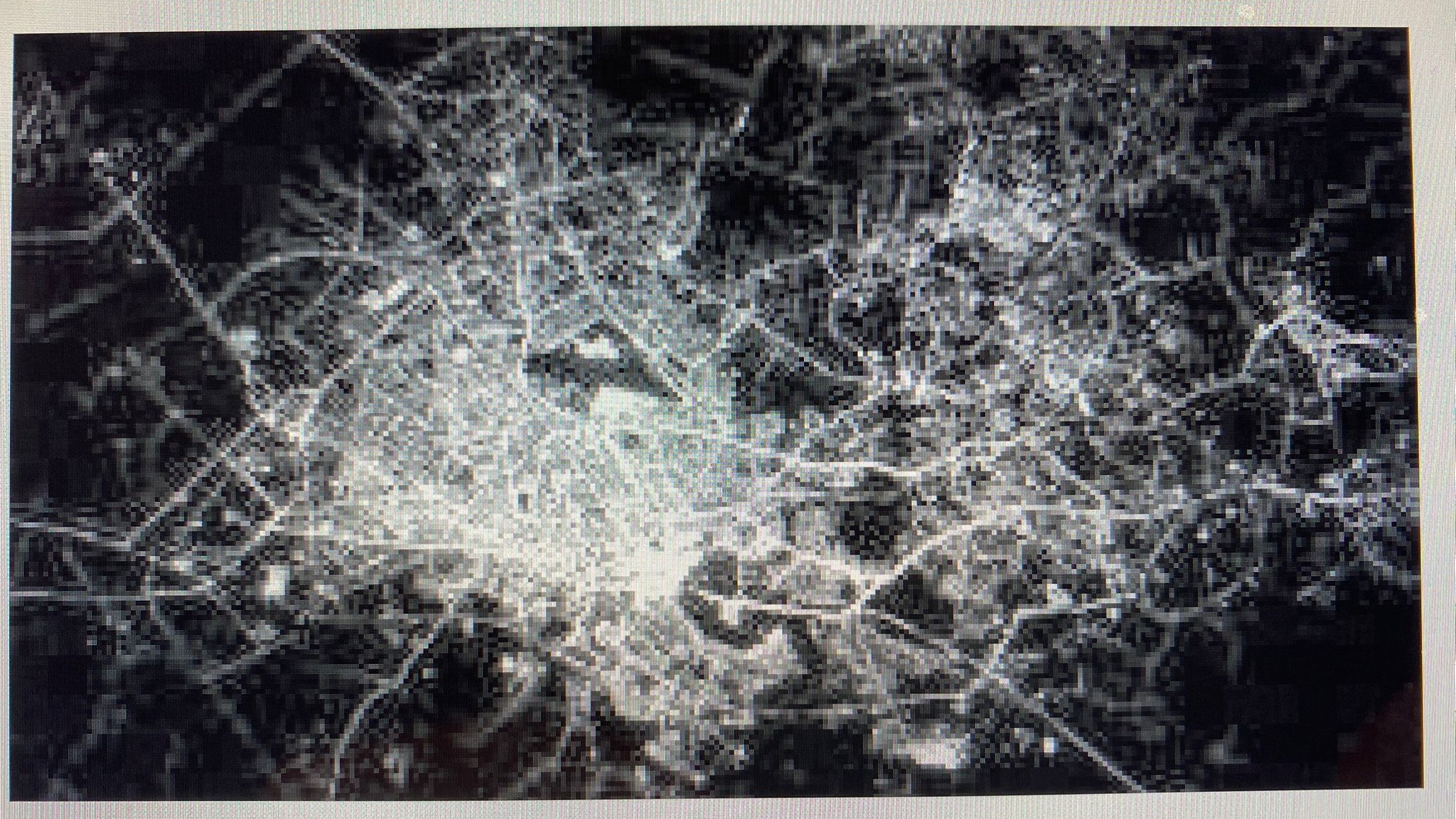
Ho Chi Minh City at night taken by Scott Kelly from space
On March 1, 2016 (US time), space scientists and billions of people witnessed astronaut Scott Kelly land on Earth in Kazakhstan. He shared with The New York Times at NASA’s press conference on March 4, 2016: “What surprised me the most was the length of a year. It seems like I’ve lived there my whole life. It seemed longer than I thought”.
The hero happily told the press: “The agency has numerous talented people and I have no reason to go up there again (...). Maybe in 20 years, you can buy cheap tickets for a short visit there”. Kelly’s talent and sacrifice for today’s space science will undoubtedly be recognized by humanity. The man “carrying the space gene” - the center of that world, came to Mozart’s hometown this afternoon, so gentle, sincere, and courteous.
P/s: Thank you for all the references from our journalist colleagues, Time Magazine, the New York Times, NASA, the UN....
PROMOTED
On April 10, 2022 (ie the 10th day of the third lunar month), the Global Vietnam National Fatherland Day Project Board, the Center for Intercultural, Science and International Communication coordinated with individuals, units and organizations. Associations, overseas communities and international friends from more than 30 countries around the world to organize online: "Viet Nam Ancestral Global Day 2022 - Holy Ancestral Anniversary and Honoring the descendants of Hung King globally ".
WAJ- Grammy-Winner Georg O. Luksch and "Ada Christen - The Voice oft the lost ones``
- Vietnamese female director wins prize at amsterdam international documentary film festival 2021
- New Belgian Ambassador presents credentials, begins his term in Vietnam
- Tran To Nga - 15-year odyssey in pursuit of justice for Vietnam's Agent Orange victims


MOST VIEWED
-
1
BEAUTY WITH A PURPOSE: MISS SEA VIETNAM GLOBAL 2025 AND THE JOURNEY TO THE WORLD STAGE

-
2
Initial indicators: Right-wing Freedom Party FPÖ wins Austrian parliamentary elections

-
3
A 17th-Generation Descendant of King Le Kinh Tong Brings the Hung Kings’ Statue to Be Enshrined Abroad

-
4
International Festival Charity Bazaar

-
5
Egypt’s Efforts in Addressing the Gaza Crisis

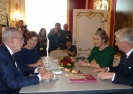
The two Kings Philippe and Van der Bellen havedifferent backgrounds, one is of royal origin, and the other is a child of a refugee family (once of noble origin) but now, in the eyes of the European public, both of them are giving off a sense of courtesy, virtue and erudition.
WAJ
With the attendance of many international figures, the 80th anniversary of the end of World War II was celebrated at the United Nations headquarters.
Journalist Usama Soliman

Comment