




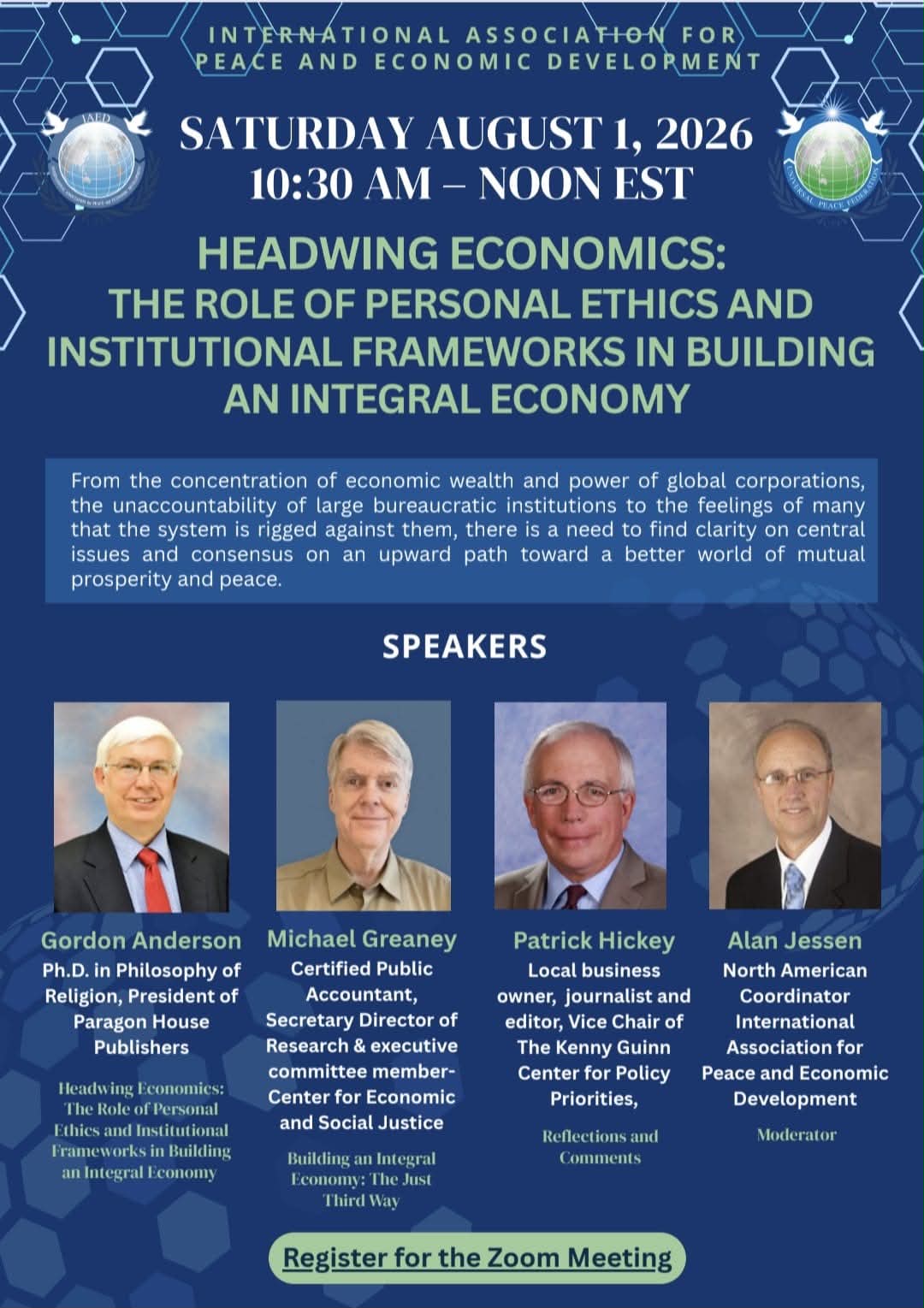
The official poster for IAED's international online forum. (Photo: IAED)
Beyond an Economic Crisis
For decades, the world's economic debate has revolved around familiar questions: How much freedom should markets have? How much should governments intervene?
Yet the defining challenges of the twenty-first century extend far beyond inflation, unemployment, or GDP growth.
The concentration of wealth in the hands of a small number of global corporations, growing distrust of public institutions, and a widespread perception that economic systems no longer serve ordinary citizens have intensified calls for a new development paradigm. Social polarization, political instability, and declining confidence in governance have become increasingly interconnected with economic concerns.
According to IAED, these challenges are not merely policy failures. They also reflect a deeper erosion of ethical values within the institutions that shape economic life. The organization's upcoming forum seeks to explore whether long-term prosperity requires not only sound economic policies but also a renewed moral foundation.
Introducing "Headwing Economics"
At the center of the discussion is Headwing Economics, a conceptual framework promoted by IAED that seeks to move beyond the traditional ideological divide between free-market capitalism and state-centered economic systems.
Rather than rejecting markets or government, the framework argues that both should be guided by universal ethical principles. Markets remain essential for innovation and entrepreneurship, while public institutions are expected to ensure fairness, accountability, and equal opportunity. Together, they should operate within a culture that places human dignity, responsibility, and the common good at the heart of economic development.
The concept also emphasizes expanding access to productive ownership, strengthening institutional transparency, and recognizing the importance of families and communities as foundational economic actors.
While Headwing Economics is not an established school of economic thought within mainstream academia, IAED presents it as a framework for dialogue and interdisciplinary exploration on the ethical dimensions of sustainable development.
A Cross-Sector Conversation
The forum brings together scholars, economists, business leaders, and media professionals, underscoring the belief that today's economic challenges cannot be addressed by any single discipline.
Dr. Gordon Anderson, President of Paragon House Publishers, will deliver the keynote presentation on the relationship between personal ethics and institutional frameworks in building an integral economy.
Michael Greaney, a Certified Public Accountant and Secretary of the Center for Economic and Social Justice, will discuss "The Just Third Way," an approach that advocates expanding access to productive capital and economic opportunity.
The discussion will be followed by reflections from Patrick Hickey, businessman, journalist, and Vice Chair of The Kenny Guinn Center for Policy Priorities. The session will be moderated by Alan Jessen, IAED's North American Coordinator.
By bringing together perspectives from academia, business, public policy, and journalism, the organizers hope to encourage a broader international conversation about the ethical foundations of economic systems.
A Question for the Twenty-First Century
Artificial intelligence, digital transformation, climate change, and geopolitical fragmentation are reshaping the global economy at an unprecedented pace.
Against this backdrop, the central question is no longer simply how economies should grow, but what kind of growth societies should pursue—and for whom.
IAED's forum does not claim to provide definitive answers to the world's complex economic challenges. Instead, it offers an opportunity to reconsider a premise that has often been overlooked in economic discourse: that sustainable prosperity may ultimately depend not only on better institutions, but also on stronger ethical commitments.
If the twentieth century was largely defined by debates over who controls economic resources, discussions such as this invite a different question for the twenty-first century:
Can humanity build an economic system in which freedom, justice, peace, and shared prosperity reinforce rather than compete with one another?
That question may well become one of the defining conversations of our time.
Event Information
Event: Headwing Economics: The Role of Personal Ethics and Institutional Frameworks in Building an Integral Economy
Organizer: International Association for Peace and Economic Development (IAED)
Date: Saturday, August 1, 2026
Time: 10:30 a.m.–12:00 p.m. EST (4:30–6:00 p.m. Vienna time)
Format: Online via Zoom: https://zoom.us/meeting/register/CZgRCiK4RHegsieVp9PCQA?mc_cid=1ad05ea859&mc_eid=0b13c9bd0d#/registration
PROMOTED


- Young translator conquers the ancient Greek classic Anabasis – Memoir of the Persian Expedition
- Austria news - Usama Nosshy channel covers Asean's 55th anniversary celebrations at the United Nations in Vienna
- VietnamPlus Newspaper reported about ASEAN's 55th anniversary at the United Nations in Vienna



MOST VIEWED
-
1
AUSTRIA – VIETNAM: UNDERSTANDING THE VALUE OF PEACE

-
2
Austria news - Usama Nosshy channel covers Asean's 55th anniversary celebrations at the United Nations in Vienna

-
3
Remarks of UNESCO Representative to Viet Nam, Christian Manhart 20 th Anniversary of Convention on the Safeguarding of the Intangible Cultural Heritage / Hung King Festival

-
4
Great Buddhist Festival 2022 in Czech Republic

-
5
The “group” and the united nations convention against corruption

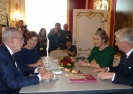
The two Kings Philippe and Van der Bellen havedifferent backgrounds, one is of royal origin, and the other is a child of a refugee family (once of noble origin) but now, in the eyes of the European public, both of them are giving off a sense of courtesy, virtue and erudition.
WAJ
With the attendance of many international figures, the 80th anniversary of the end of World War II was celebrated at the United Nations headquarters.
Journalist Usama Soliman



Comment