





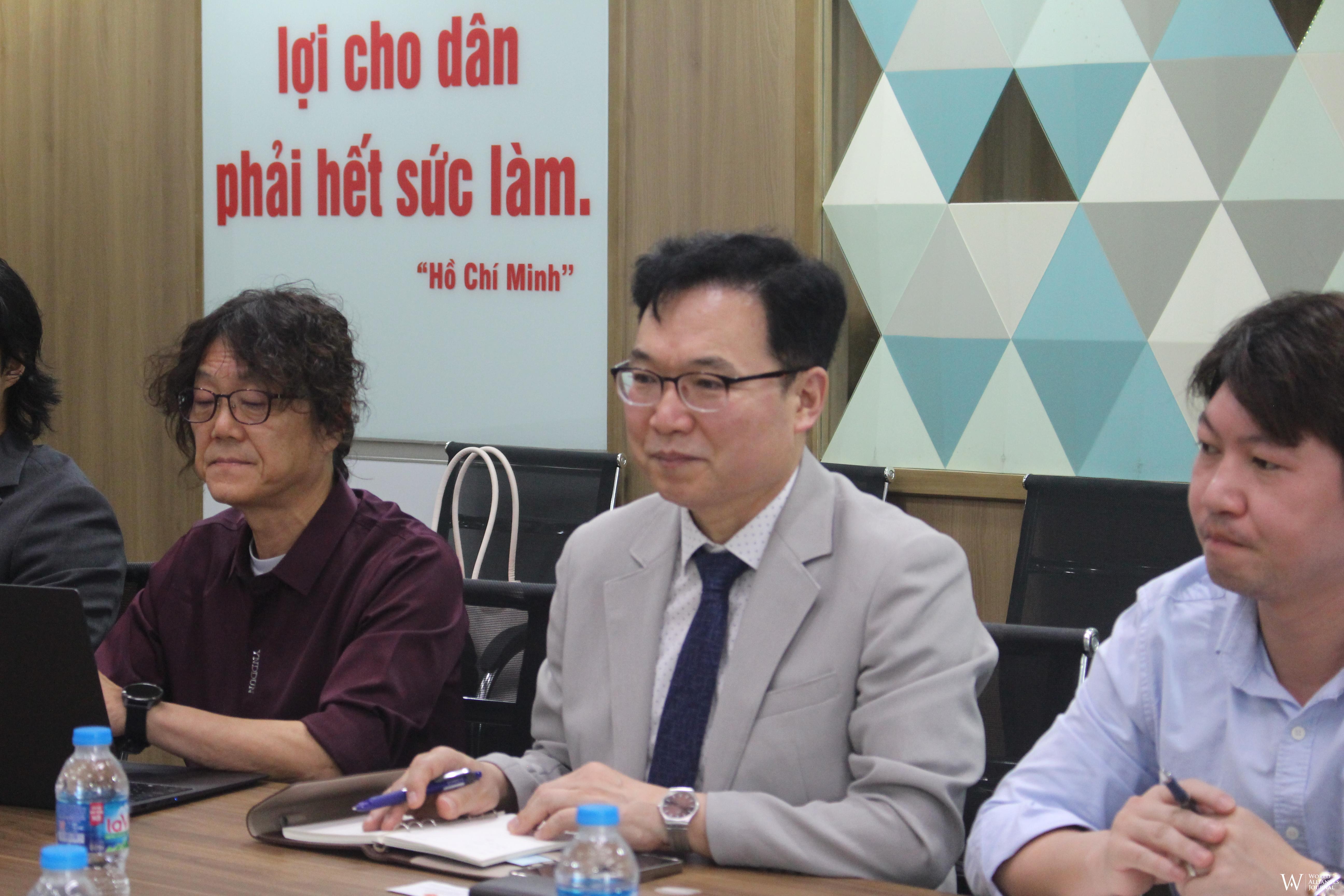
Prof. Kyoung-Kook Kim (center), Dept. of Semiconductor Eng, Director, Research Institute of Advanced Convergence Technology, Tech University of Korea. (Photo: WAJ Contributor)
WAJ: Professor, as countries around the world race to secure a place in the global semiconductor value chain, where do you believe Vietnam stands today, and what do you see as its greatest competitive advantage?
Prof. Kyoung-Kook Kim: In any industrial sector, a distinction exists between cutting-edge technology and foundational technology. While cutting-edge sectors yield high added value, they demand substantial R&D investment, highly specialized talent, and proprietary advanced technologies. Conversely, foundational technologies have lower entry barriers and exert a powerful spillover effect across adjacent fields, such as the electronics industry.
The semiconductor industry is no exception to this paradigm. Considering that Vietnam is in the nascent stages of establishing its semiconductor presence, the most strategic approach is to prioritize foundational technology. Within this domain, advanced packaging and Printed Circuit Board (PCB) sectors offer exceptional synergy with Vietnam's existing electronics manufacturing base. Furthermore, because these sectors are labor-intensive, Vietnam can fully leverage its greatest competitive advantage: a vast, dynamic pool of young engineers. Focusing national capabilities on these segments will foster robust international competitiveness. Historically, many nations that successfully anchored their semiconductor industries began with a similar trajectory.
Undoubtedly, the accelerating pace of technological evolution occasionally prompts countries to pursue simultaneous development across multiple segments. However, even in such multi-faceted approaches, a clearly defined strategic prioritization remains imperative.
WAJ: In South Korea’s development story, semiconductors have been more than just an industry they have been a catalyst for national transformation. What is the most important lesson Vietnam can learn from South Korea’s journey?
Prof. Kyoung-Kook Kim: If there is one paramount lesson Vietnam should draw from South Korea’s experience, it is the strategy of "time-compressed technological development." This refers to the organizational and strategic capability to elevate relevant technologies to a global standard within an exceptionally short timeframe. Possessing this specific experience is indispensable for entering an industry like semiconductors, where technological evolution occurs at a breakneck pace.
To successfully build an industrial foundation, advance technological capabilities, and nurture specialized talent simultaneously, two elements are absolute prerequisites: unwavering national-level support and a powerful, centralized control tower. This governing entity can be driven either by the state or by private enterprise champions. What matters most is its capacity for decisive coordination and execution.
WAJ: Many experts argue that human capital is the true “gold mine” of the semiconductor industry. In your view, what should Vietnam prioritize first: chip design engineers, R&D specialists, or the technical workforce needed for manufacturing, testing, and packaging?
Prof. Kyoung-Kook Kim: Semiconductors represent a highly comprehensive industry—a convergence of diverse sectors including materials, components, equipment, technology, and human resources. This ecosystem can be broadly bifurcated into cutting-edge sectors and foundational sectors. The cutting-edge domain relies heavily on a select group of top-tier talent to drive advanced technologies. Consequently, leading semiconductor nations maintain a fierce monopoly over this space, resulting in an exceptionally high barrier to entry. Conversely, foundational sectors demand a substantial workforce and are structurally tied to the construction of manufacturing facilities, offering the distinct advantage of driving product commercialization within a shorter timeframe.
For Vietnam, a strategic "two-pronged" approach to talent development is highly recommended to effectively enter the global semiconductor value chain. For chip design, Vietnam should nurture a select, high-caliber cohort of engineers through strategic collaborations with technologically advanced nations. Simultaneously, for manufacturing and packaging, the nation should prioritize cultivating a robust technical workforce focused on production and commercialization technologies.
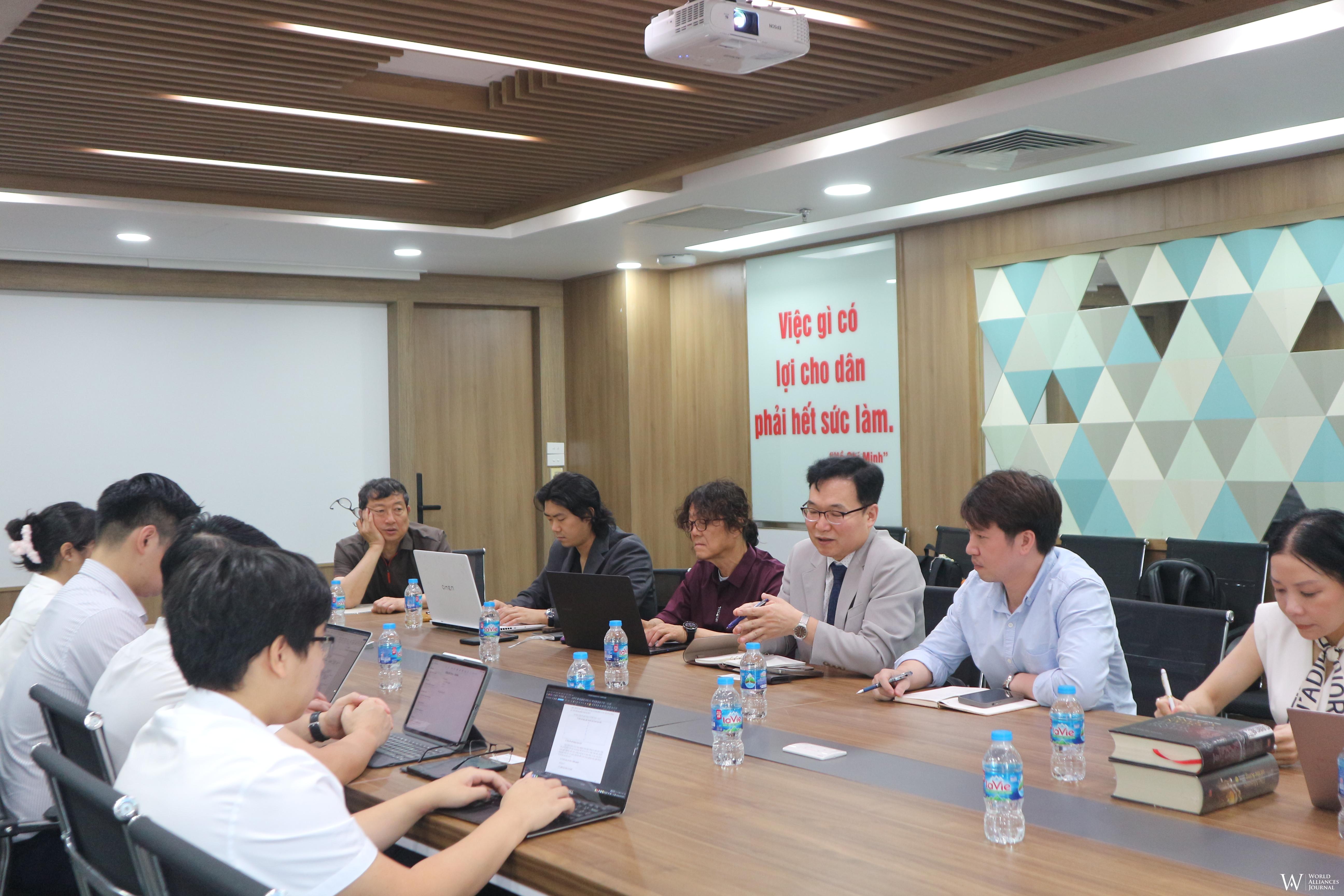
Professor Kyoung-Kook Kim (fourth from right) and representatives of Stella Avenue Investment (Korea) held a working session with the Information Technology Industry Agency under Vietnam’s Ministry of Science and Technology in Hanoi, May 2026. (Photo: WAJ Contributor)
WAJ: In partnerships between South Korean and Vietnamese universities, which is ultimately more important: the transfer of technology or the transfer of an innovation mindset?
Prof. Kyoung-Kook Kim: Both technology transfer and the transfer of an innovation mindset are indispensable pillars of a successful partnership. However, they operate on different timelines and structural levels. Realistically, technology transfer can be achieved within a relatively short timeframe, depending on the specific field and scope of collaboration. Conversely, fostering an innovation mindset is deeply intertwined with the underlying educational ecosystem. If an educational framework is not fundamentally designed to encourage creative and critical thinking, embedding an innovative mindset becomes virtually impossible.
Furthermore, while South Korea and Vietnam share cultural and historical commonalities, they also possess distinct institutional differences. Consequently, while their educational frameworks for nurturing innovation may align in principle, they cannot be identical. To cultivate talent equipped with an innovative mindset, Vietnam must ultimately develop and implement a tailored educational system that reflects its unique socio-economic landscape and institutional realities.
WAJ: Vietnam has attracted major global players such as Samsung, Intel, and Amkor. In your opinion, what must Vietnam do to move beyond being a manufacturing base and become a creator of technology and intellectual property?
Prof. Kyoung-Kook Kim: South Korea’s semiconductor industry advanced to its current global standing from a state of absolute void lacking both foundational technology and specialized talent. Samsung played the most pivotal role in this transformative journey. Under decisive leadership, Samsung first identified strategic target products viable for localized manufacturing and subsequently established a robust, integrated "industry-academia-research" collaborative ecosystem to drive technological development. This aggressive leadership enabled the rapid consolidation of relevant technologies within an exceptionally short timeframe, ensuring a successful initial market entry. Post-entry, continuous and highly focused R&D investments allowed South Korea to secure definitive global technological leadership. Crucially, this entire process was preceded by meticulously crafted strategies to select the right technologies and products tailored to market demands and Samsung's core capabilities.
What about Vietnam’s current position? While attracting global giants is undeniably an exceptional catalyst and highly beneficial for the nation's semiconductor evolution, we must recognize a fundamental truth: the semiconductor industry is not merely a highly lucrative commercial sector; it is a strategic asset directly tied to national security. Consequently, the more prominent a global corporation is, the more stringently it protects its intellectual property and the more conservative it becomes regarding advanced technology transfer. This represents a formidable barrier that Vietnam, as a latecomer, must strategically overcome. However, I am entirely confident that by rigorously studying South Korea’s historical trajectory and adapting those proven methodologies to fit Vietnam’s unique domestic context, Vietnam can successfully cross this threshold.
WAJ: Vietnam aims to train approximately 50,000 semiconductor professionals by 2030. What do you see as the greatest challenge in transforming this ambitious target into a workforce that can compete on a global stage?
Prof. Kyoung-Kook Kim: Unlike in the past, the contemporary semiconductor industry is evolving simultaneously across multiple diverse domains, including AI, automotive electronics, and telecommunications. To keep pace with this rapid technological evolution, nurturing top-tier talent is the absolute first priority. In this regard, Vietnam’s target to train 50,000 semiconductor professionals is a highly rational and excellent strategic decision.
The critical challenge, however, lies in establishing a comprehensive post-training roadmap so that talent cultivation does not exist in a vacuum. This means a robust domestic industry must be prepared to absorb these newly minted professionals. If Vietnam trains an extensive workforce without actively provisioning corresponding high-quality jobs, the talent produced will be unable to contribute to the nation’s domestic semiconductor advancement, potentially leading to critical brain drain.
True expertise is finalized in the field; when engineers actively participate in production lines, they acquire invaluable operational know-how and yield-optimization skills that far exceed what can be taught in a classroom. Consequently, they begin to develop next-generation technologies. Therefore, alongside graduating semiconductor technical experts, I strongly recommend that Vietnam concurrently implement aggressive industrial policies to guarantee the creation of high-tech jobs capable of absorbing this workforce.
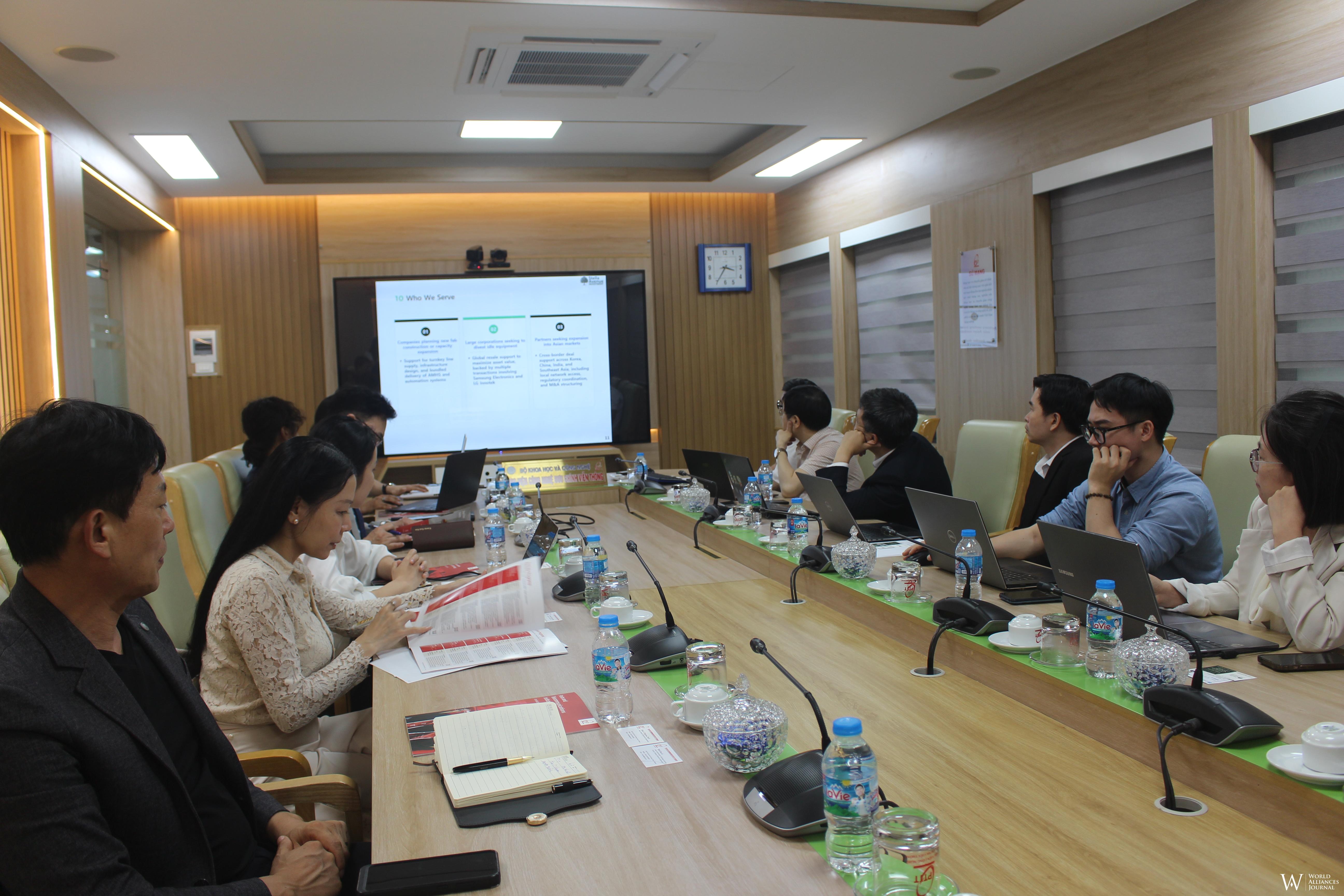
Representatives of Stella Avenue Investment and Professor Kyoung-Kook Kim held preliminary discussions with the Posts and Telecommunications Institute of Technology (PTIT) on potential directions for future cooperation in Hanoi, May 2026. (Photo: WAJ Contributor)
WAJ: Many countries have invested heavily in technology education, yet only a few have succeeded in building a thriving semiconductor ecosystem. As Vietnam stands before what many describe as a historic opportunity, what is the biggest mistake it must avoid? And if you could deliver just one message to the Vietnamese government, universities, and business community, what would it be to ensure that Vietnam does not miss its “golden moment” in semiconductors?
Prof. Kyoung-Kook Kim: Building a semiconductor ecosystem within a single nation is an extraordinarily formidable endeavor. However, once established, such an ecosystem serves as a powerful pillar of national competitiveness, generating massive economic and technological spillover effects. It is precisely for this reason that nations worldwide continuously vie to anchor this industry.
During the nascent stages of ecosystem development, encountering trial and error is inevitable. Embarking on an unprecedented path naturally entails missteps; yet, it is through analyzing these very failures that both nations and individuals learn and mature. The true pitfall is not the occurrence of trial and error itself, but the failure to prevent its repetition.
To mitigate these costly inefficiencies, the Government must actively collaborate with seasoned experts specifically those who possess a proven track record of industrial success to meticulously design policies and exercise decisive leadership to ensure the "selective concentration" of both human and financial resources. Expanding into an overly broad spectrum of technology sub-sectors from the outset is strongly discouraged.
Universities, when identifying fields of competitive advantage, must align themselves closely with robust industrial sectors and corresponding enterprises. The primary focus of talent cultivation should be centered on technological domains that guarantee high-quality job creation. Most critically, institutions must shift their paradigm from graduating students based on "what the university is capable of teaching" to "what the industry urgently requires." This is a paramount distinction, and it is precisely here where the strategic guidance of the government is most crucial.
Finally, the Business Community must conduct rigorous market assessments to identify which semiconductor products can achieve definitive global competitiveness, and aggressively internalize the corresponding core technologies. Waiting passively for material subsidies, technology transfers, or talent supply from the government and academia will inevitably cause companies to miss critical market entry windows. In the historical case of South Korea, it was the private enterprises that moved first and most aggressively.
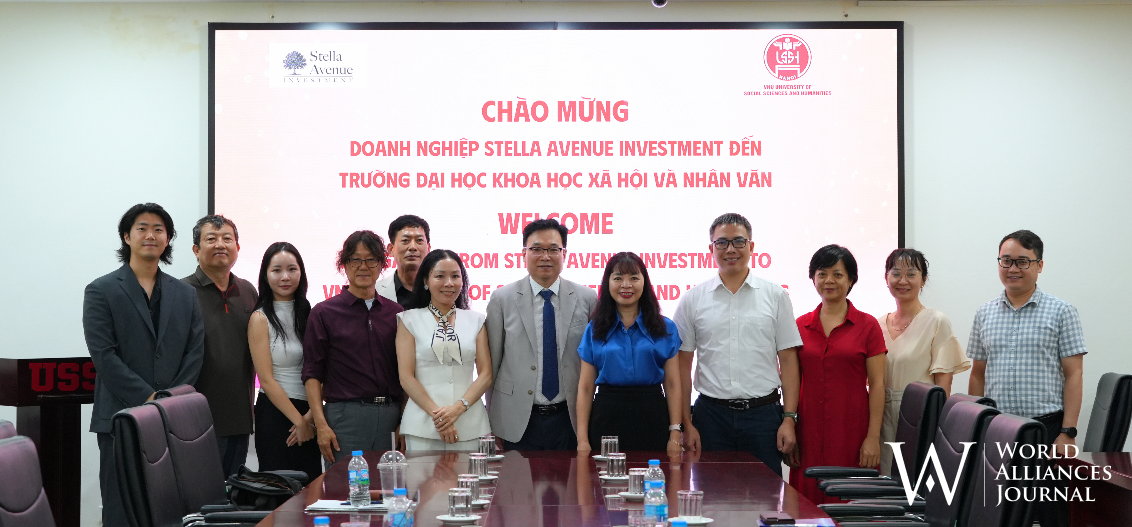
Professor Kyoung-Kook Kim (sixth from right) emphasized the importance of media and journalism activities, alongside academic research, in advancing the semiconductor industry during a meeting between a Korean delegation and the VNU University of Social Sciences and Humanities in May 2026. (Photo: WAJ Contributor)
WAJ: If you were given the task of building Vietnam’s semiconductor industry from the ground up over the next decade, what would be the first three actions you would take and why?
Prof. Kyoung-Kook Kim: If I were entrusted with the task of architecting Vietnam’s semiconductor industry, I would implement a strategic 10-year (or preferably accelerated 5-year) roadmap focused on the following three foundational actions:
First, I would identify and select 10 specific semiconductor products where Vietnam can achieve definitive global market leadership. In reality, even if Vietnam successfully manufactures just five world-class products within this timeframe, the nation will naturally anchor itself as an indispensable node in the global semiconductor supply chain and secure robust national competitiveness. These target products do not necessarily need to be high-profile, cutting-edge devices like GPUs or HBMs. For advanced chips to function, they require an array of foundational materials and components. If Vietnam corners the global market for any of these critical inputs, global tech giants will inevitably rely on Vietnamese products to operate their own high-end devices. This specific product leadership will subsequently serve as a springboard for broader technological advancement and sophisticated product development.
Second, I would institute a highly strategic "Talent Cultivation Policy" aligned precisely with our target products. Semiconductor advancement is fundamentally knowledge-driven; however, raw numerical output of graduates is insufficient. Vietnam must cultivate a specialized workforce tailored to the specific demands of each sub-sector. Specifically, I would tie human resource development programs directly to the core technologies required for manufacturing the aforementioned world-class target products. Technological disciplines that do not directly translate into immediate product commercialization should, programmatically, be deprioritized in terms of national subsidy allocation. Furthermore, I would establish public-private educational initiatives with enterprises operating in these target sectors. This involves co-developing training curricula that transition seamlessly from academic instruction to intensive, field-level On-the-Job Training (OJT). Nurturing "field-ready, practical talent" is an absolute prerequisite for Vietnam’s industrial progression.
Third, I would formulate an aggressive investment policy optimized for high ROI (Return on Investment) through rigorous prioritization. Semiconductor superpowers like the United States, South Korea, and Taiwan are currently locked in a high-stakes, capital-intensive race, mobilizing astronomical human and financial resources. For a latecomer nation, entering this fiercely competitive landscape with constrained capital is a formidable challenge, and succeeding is rarer still. Therefore, rather than diluting resources across the entire semiconductor value chain, Vietnam must practice "selective concentration" funneling capital into specific, highly viable niches.
To illustrate, consider the 12-inch silicon (Si) wafer, an absolute necessity for all semiconductor manufacturing. Japan's Shin-Etsu and SUMCO combined control over 50% of this global market. While Japan may appear less visible in the headlines regarding finished processor chips, its market supremacy in materials and equipment remains unmatched worldwide. If Vietnam can manufacture ultra-high-purity 12-inch silicon wafers with world-leading quality and cost-competitiveness, Vietnam will instantly transform into an irreplaceable nation within the global semiconductor ecosystem.
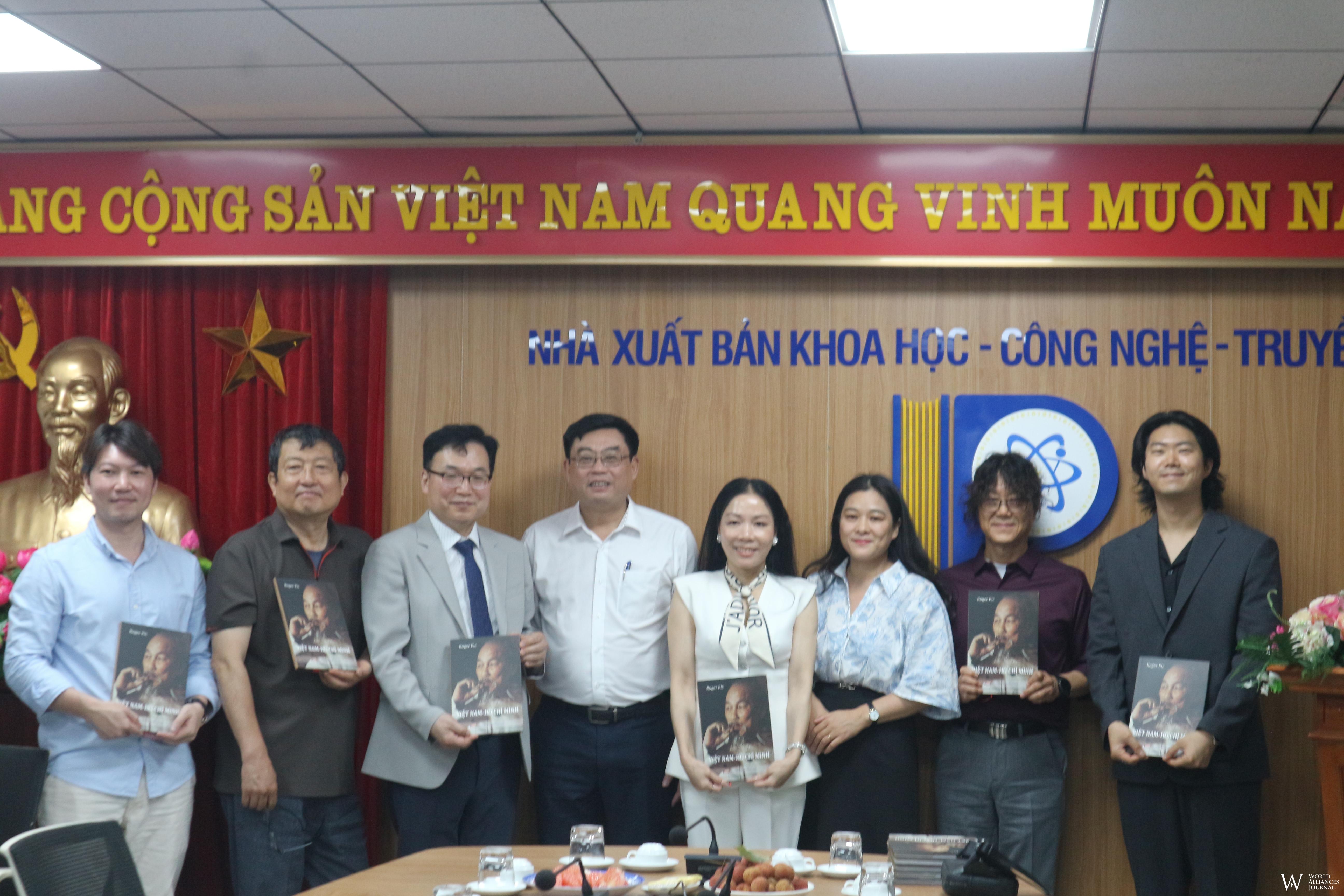
Professor Kyoung-Kook Kim expressed his desire to contribute to the future development of Vietnam’s semiconductor industry. (Photo: WAJ Contributor)
WAJ: What does Vietnam need to do to become globally competitive in the semiconductor industry?
Prof. Kyoung-Kook Kim: Ultimately, no one doubts Vietnam’s immense potential. Countless global experts confidently project that the nation will play a monumental role in the future of high technology.
However, translating this raw potential and optimistic projection into tangible reality depends entirely on the strategic caliber of the policies and investments Vietnam deploys moving forward.
One absolute certainty remains: the ultimate objective must center on creating world-class, market-leading products and this can only be realized when specialized talent, core technology, and capital investment are executed in perfect synchronization.
I sincerely look forward to seeing Vietnam secure definitive global competitiveness in the semiconductor arena, and I will continuously offer my strongest support for its journey ahead.
WAJ: We sincerely thank you, Professor Kim Kyoung-Kook, for sharing your valuable insights with WAJ. We wish you good health and continued success.
PROMOTED

The 45th EU-ASEAN Anniversary Summit of their dialogue partnership will be held on December 14 in Brussels, Belgium. Total EU-ASEAN trade has reached €140 billion in the last ten years. Vietnam is cited as an example among the countries making efforts to promote cooperation between the two blocs, such as France, Germany, Belgium, and Vietnam.
Dr. Yen Platz
- Musician Jürgen Buch expressed: “I hope Vietnamese music will spread around the world”
- AUSTRIA ELECTION 2024 (Part 1)
- Vienna Opens Windows of Truth: Sudan’s Cry for Justice Echoes Through a High-Level Humanitarian Briefing
- Building Bridges Through Taekwondo: The Bangladesh Taekwondo Union's Partnership with the World Police Taekwondo Federation

- Young translator conquers the ancient Greek classic Anabasis – Memoir of the Persian Expedition
- Austria news - Usama Nosshy channel covers Asean's 55th anniversary celebrations at the United Nations in Vienna
- VietnamPlus Newspaper reported about ASEAN's 55th anniversary at the United Nations in Vienna





MOST VIEWED
-
1
Experts' perspectives on economics development of Vietnam

-
2
Global integration brand - global summit: mosaics of the king 2022

-
3
The Atom and the Algorithm: A New Technological Alliance Takes Shape

-
4
Perspectives From Abroad on Vietnam Ahead of Party Congress

-
5
TALKSHOW HUNG KING’S 65: THE MOSAICS OF THE KING XVI


The two Kings Philippe and Van der Bellen havedifferent backgrounds, one is of royal origin, and the other is a child of a refugee family (once of noble origin) but now, in the eyes of the European public, both of them are giving off a sense of courtesy, virtue and erudition.
WAJ
With the attendance of many international figures, the 80th anniversary of the end of World War II was celebrated at the United Nations headquarters.
Journalist Usama Soliman



Comment