





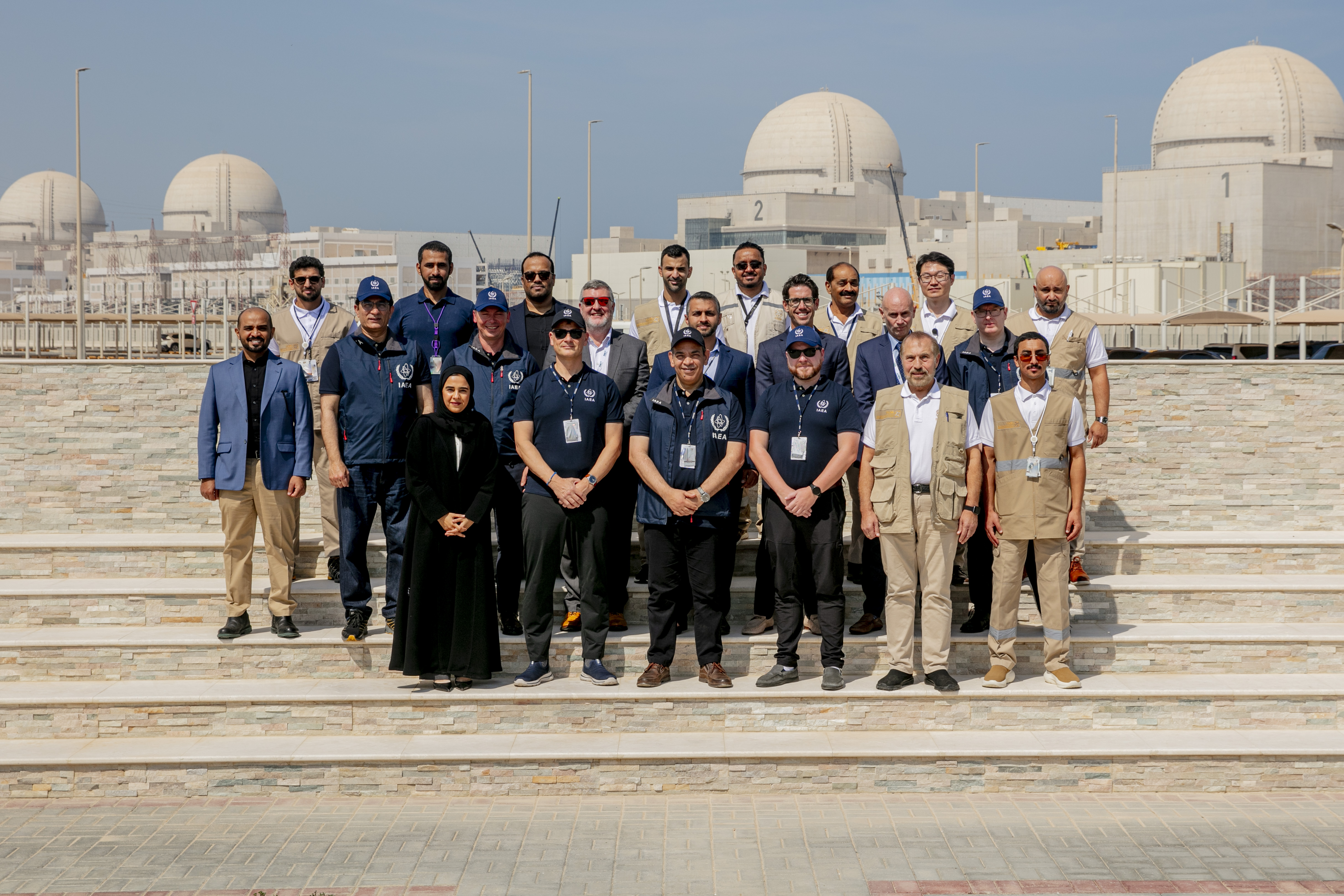
IAEA, BNPP and FANR teams during the recent IAEA mission at the BNPP in the UAE. (Photo: FANR)
An International Atomic Energy Agency (IAEA) mission has concluded that the United Arab Emirates (UAE) authorities and the Barakah Nuclear Power Plant (BNPP) had appropriately responded to the loss of off-site power at Unit 3 following a drone strike on 17 May 2026. The mission found that effective measures were taken to maintain safety during the incident, including prompt national and international notification, the implementation of established emergency response procedures and communication with the public.
Conducted from 12 to 20 October 2026 at the request of the UAE government, the mission followed an agreement reached between IAEA Director General Rafael Mariano Grossi and the Emirati government during his visit to BNPP in June 2026. The six-member team examined the plant's response to the incident, reviewed emergency arrangements and assessed lessons learned.
The team visited affected areas of the plant and key emergency response facilities, reviewed operating and emergency procedures, and met senior management and technical staff from BNPP and the Federal Authority for Nuclear Regulation (FANR), the UAE's independent nuclear regulator. Its work focused on the actions taken at the plant, national arrangements for emergency preparedness and response, lessons learned from the event, and the operator's arrangements for ensuring safety.
IAEA Mission Recognizes Effective Response and Safety Measures
Amgad Shokr, Director of the IAEA Incident and Emergency Centre and leader of the mission team, said the decision by FANR and BNPP to request the assessment demonstrated their commitment to safety and continuous improvement.
“By requesting this mission, FANR and BNPP have demonstrated their strong commitment to safety and continuous improvement,” Shokr said.
He encouraged FANR and ENEC to continue implementing the organizational and technical measures identified through the assessment of lessons learned from the incident. These measures are intended to further enhance safety and strengthen emergency preparedness and response arrangements in line with IAEA safety standards.
The mission identified several good practices and positive results. These included the UAE authorities' adoption of the IAEA's Seven Indispensable Pillars for Nuclear Safety and Security, the successful restoration of off-site power within a short period, effective regulatory oversight, strengthened safety procedures, training for operating staff and improvements to the resilience of critical infrastructure based on lessons learned from the incident.
Recommendations Focus on Emergency Preparedness and Infrastructure
Alongside its positive findings, the mission recommended further improvements to emergency preparedness and response arrangements, the reliability and resilience of critical infrastructure, and coordination among relevant stakeholders. The recommendations aim to ensure that nuclear safety and security measures are effectively integrated.
In her remarks at the conclusion of the mission, Karine Herviou, IAEA Deputy Director General and Head of the Department of Nuclear Safety and Security, said the team had recognized the UAE's strong record of engagement with the Agency.
Herviou emphasized that the value of an international mission lies not only in confirming what worked, but also in identifying lessons and opportunities for continuous improvement. She said the team had recognized the technical knowledge and competence of FANR, BNPP management and operating personnel, and national electrical grid field operators.
UAE Reaffirms Commitment to Nuclear Safety and Security
Hamad Al Kaabi, Director General of FANR, said the UAE had established a robust and comprehensive nuclear emergency preparedness and response system in line with the highest international standards, developed in close cooperation with the IAEA.
“The UAE shares the position of the international community and the IAEA on the importance of protecting nuclear facilities at all times,” Al Kaabi said.
He said the UAE had responded swiftly and effectively to the incident, applying the IAEA's Seven Indispensable Pillars for Nuclear Safety and Security. He added that the mission reflected the country's continued commitment to high standards of nuclear safety, security and emergency preparedness, drawing lessons from experience and strengthening national capabilities.
Al Kaabi said the UAE would continue working closely with the IAEA and national partners to enhance the safety and security of nuclear facilities and ensure the protection of the community and the environment.
Barakah's Role in the UAE's Electricity Supply
The Barakah Nuclear Power Plant is operated by ENEC Operations, a joint-venture subsidiary of the Emirates Nuclear Energy Company (ENEC) and Korea Electric Power Corporation (KEPCO).
The facility is located in the Al Dhafra region of the Emirate of Abu Dhabi on the Arabian Gulf, approximately 53 kilometres west-southwest of Al Dhannah City.
According to the IAEA statement, the plant's four APR1400 reactors produce 40 terawatt-hours of electricity annually, equivalent to around 25 percent of the UAE's electricity needs.
The May incident involved a loss of off-site power at Unit 3. The IAEA mission reviewed the response to the event, including the measures taken to maintain safety and the restoration of the external power supply.
Further Cooperation May Follow
The mission concluded that the UAE authorities and BNPP had appropriately responded to the May incident. While recognizing the measures taken to maintain safety, the team also identified recommendations intended to strengthen emergency preparedness and response, improve the resilience of critical infrastructure and reinforce coordination among relevant stakeholders.
As part of the UAE's ongoing cooperation with the IAEA, follow-up missions will be considered in the future.
Photo Credit: FANR
Mission Dates: 12–20 October 2026
Location: Barakah Nuclear Power Plant, Abu Dhabi, United Arab Emirates
PROMOTED

With the attendance of many international figures, the 80th anniversary of the end of World War II was celebrated at the United Nations headquarters.
WAJ



MOST VIEWED
-
1
Nuclear Science and Global Security Take Center Stage at IAEA Conference

-
2
Friends immigrate

-
3
Who has given me to hanoi - entrepreneur Dinh Thi Kim Dung, company director handelsagentur kim trading, Austria

-
4
Season of love in Karlovy Vary

-
5
Respiratory Medicine Congress in Vienna warns of long-term exposure to air pollution and lack of green spaces

The two Kings Philippe and Van der Bellen havedifferent backgrounds, one is of royal origin, and the other is a child of a refugee family (once of noble origin) but now, in the eyes of the European public, both of them are giving off a sense of courtesy, virtue and erudition.
WAJ
With the attendance of many international figures, the 80th anniversary of the end of World War II was celebrated at the United Nations headquarters.
Journalist Usama Soliman



Comment