





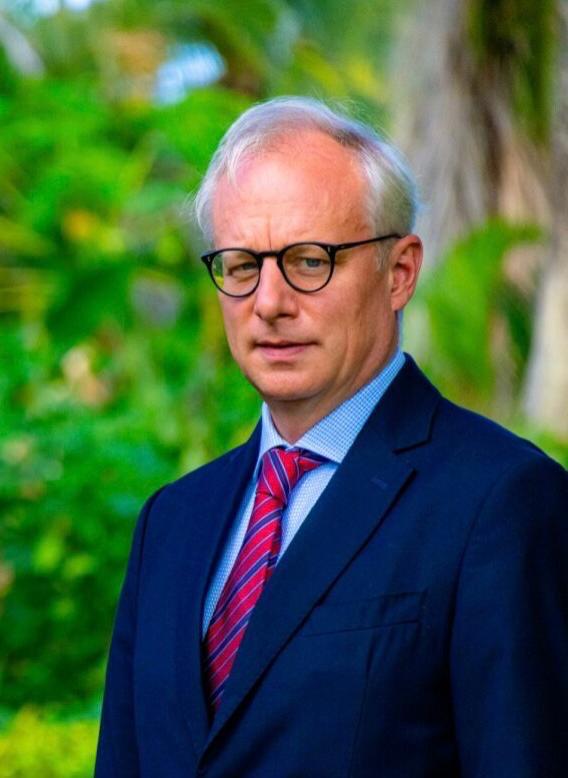
Dr. Marcus Brand, Global Goodwill Ambassador, Korea Democracy Foundation. (Photo: International IDEA)
Trust, Constitutions and the Language of Peace
WAJ: On the occasion of the International Day of Peace on September 21, after many years of working across different countries and contexts, what do you believe are the most important foundations for building and sustaining peace in a society?
Dr. Marcus Brand: In my experience across Kosovo, Ukraine, Nepal, Myanmar and the Pacific, peace does not begin with the absence of conflict. It begins with the presence of trust. Trust that institutions will treat people fairly, that disagreements can be settled without violence, and that today's minority will not become tomorrow's target. The most durable peace I have seen rests on three foundations: functioning rule of law, inclusive institutions that give every community a stake in the outcome, and a shared sense of dignity that survives even deep political disagreement.
Recent developments in the Western Balkans, particularly in Serbia and Kosovo, show how closely this is tied to a country's own honesty about itself. How a society deals internally with accountability and with its own record shapes its national narrative, and that narrative, in turn, shapes how peace holds with its neighbours. Internal truthfulness and external peace are not separate things. They reinforce each other.
WAJ: Drawing on your experience in constitutional reform, how do you see the role of a constitution in creating stability, public trust and peaceful coexistence within a society?
Dr. Marcus Brand: A constitution can be seen as a social contract, a peace agreement written for the long term. But it matters greatly what that constitution actually enshrines. Having worked on constitutional questions in contexts as different as Kosovo, Ukraine, Tunisia, Fiji and Myanmar, I have seen constitutions that were built mainly to legitimize one leader's or one party's grip on power, dressed up in constitutional language. Those tend to be fragile. Sooner or later they get challenged, often at real cost, because they were never designed to serve the public in the first place.
A constitution earns trust not through the elegance of its text but through how consistently and fairly it is applied. At the same time, a constitution has to do two things that can pull against each other: it needs to provide real stability, and it needs enough flexibility to change as circumstances change. A constitution frozen in place is as much at risk as one with no real substance behind it. Also, constitutions need to organize and structure political power, enabling the state to be effective, but at the same time limit those powers, respecting individual freedoms or regional differences, for instance in the form of federalism. When people believe the rules will not be bent for the powerful, and that the rules can still evolve honestly over time, they are far more willing to accept outcomes they personally dislike. That is what makes peaceful coexistence possible.
WAJ: In your view, how can the rule of law become a “language of peace,” particularly in societies where people hold different interests, perspectives and aspirations?
Dr. Marcus Brand: Societies rarely agree on all interests or aspirations, and they should not be expected to. What the rule of law offers is a shared grammar for disagreement, a way of contesting power and resources that does not require anyone to be silenced or eliminated. When courts, elections and legal procedures function honestly, people with very different visions for their country can still recognize the outcome as legitimate. That recognition, more than consensus itself, is what keeps a plural society peaceful.
Democracy, Diversity and the Right to Be Heard
WAJ: You have lived and worked in countries across Asia, Europe and other regions. How have these experiences shaped your understanding of the relationship between democracy, diversity and peace?
Dr. Marcus Brand: Working across East and Central Asia, Southeast Asia, Ukraine and the Pacific has convinced me that diversity is never the problem itself. It is usually the excuse used to justify power grabs or governance failures. In Fiji, in Myanmar, in the Balkans, the deepest conflicts arose not from the fact of difference but from institutions that allocated power and resources unequally along those lines of difference. Democracy, when it works, is precisely the mechanism that lets diverse societies govern themselves without any single group needing to dominate the rest. That is why I have come to see genuine democratic practice, not uniformity, as diversity's best protection.
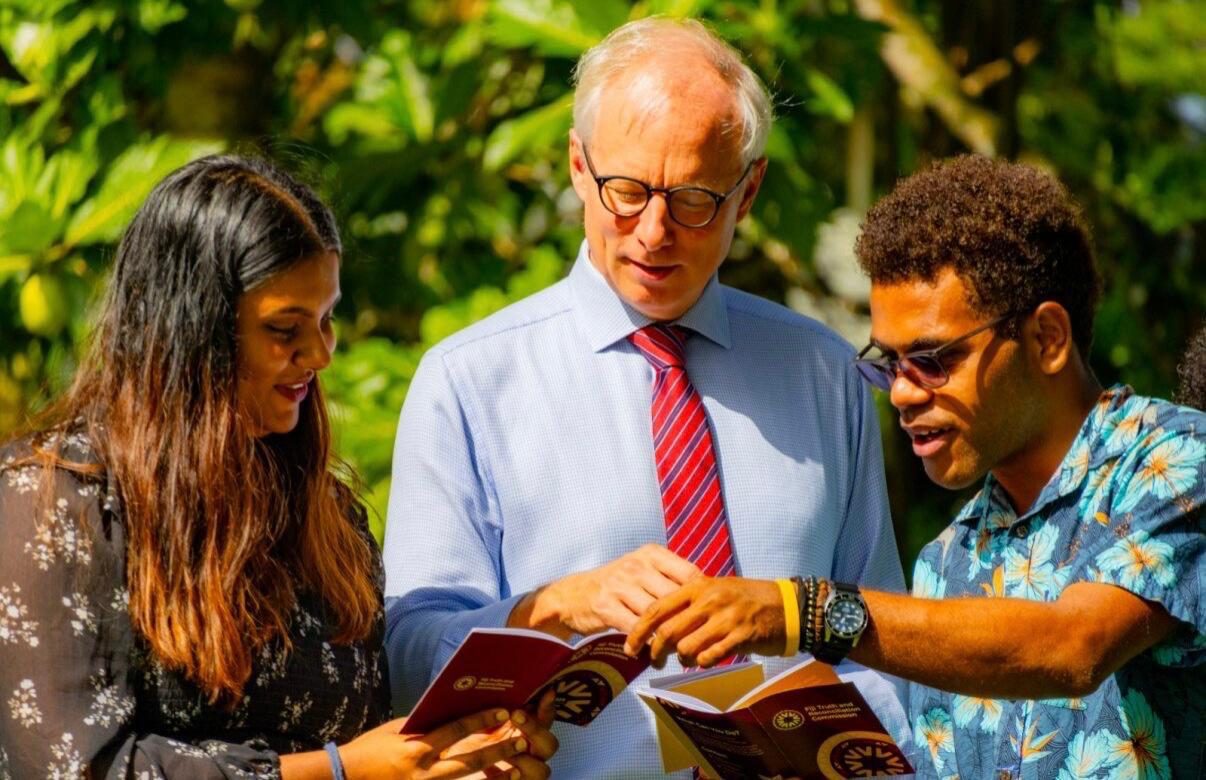
Dr. Marcus Brand with colleagues. (Photo: International IDEA)
WAJ: In processes of institutional and democratic reform, how can dialogue and meaningful public participation help different communities find common ground?
Dr. Marcus Brand: In every reform process I have supported, the moment communities began to trust the process was rarely the moment they got everything they wanted. It was the moment they felt genuinely heard, with their concerns visibly shaping the outcome even in part. Meaningful public participation is not a symbolic hearing at the end of a drafting process. It needs to happen early enough to change the substance of what is being decided. That is what turns a reform from something imposed on communities into something built with them.
WAJ: You have participated in international forums and spoken at the United Nations on issues related to democracy, the rule of law and governance. From these experiences, what do you believe is most important for turning international dialogue into a force for peace?
Dr. Marcus Brand: International forums do a great deal of good in setting standards and creating pressure for accountability. But dialogue becomes a force for peace only when it connects to real, on-the-ground experience, and not only to declarations.
One example I keep coming back to is South Korea. As Global Goodwill Ambassador for the Korea Democracy Foundation, I have studied and presented on how South Korea confronted its own authoritarian past through truth-seeking and accountability, and how that honest reckoning became part of what made its later democracy resilient. That is the kind of experience international dialogue should be built around: not abstract principles alone, but countries and practitioners sharing what actually worked, and what did not.
From Political Transition to Lasting Peace
WAJ: From the perspective of law and governance, what helps transform a peace agreement or political transition into lasting peace, rather than simply a period of stability?
Dr. Marcus Brand: A peace agreement or transition creates a pause in the conflict. It does not by itself create peace. What determines whether that pause becomes lasting is whether the institutions built afterward actually deliver. Whether courts function, whether elections are credible, and whether truth and reconciliation processes give victims a genuine hearing rather than a token one.
From founding the Fiji Truth and Reconciliation Commission, I have learned that truth-seeking only works if it is survivor-centered and trauma-informed. It has to be designed around what survivors need in order to tell their story safely and be believed, not around what is convenient for institutions. Timor-Leste's Chega process, which I have studied closely, is one of the clearest examples of truth-seeking done as a healing-oriented process, anchored in memory institutions and in education, so that what is learned does not stay locked in an archive but becomes part of how younger generations understand their own history. Truth-seeking, memory institutions, and social cohesion education working together is what turns a transition into something a society can actually build on.
WAJ: After more than two decades of international work and experience in different countries, what is one lesson about peace that you believe societies, despite their very different circumstances, can learn from one another?
Dr. Marcus Brand: Despite the enormous differences between Kosovo, Ukraine, Myanmar, Nepal and the Pacific, one lesson keeps recurring. Societies heal at the pace of their institutions, collective narratives and mindsets, not at the pace of their agreements. A signed accord can happen in a day. Rebuilding the everyday trust people place in courts, elections and public administration takes years, often a generation. Societies that accept this and invest patiently in institutions and opening up narratives and mindsets tend to consolidate peace. Those that expect an agreement alone to deliver peace are often disappointed.
WAJ: On the International Day of Peace, September 21, 2026, if you could share one message with the international community from the perspective of someone who has spent many years working on democracy, constitutionalism and the rule of law, what would you wish to say?
Dr. Marcus Brand: After more than two decades in this field, I remain convinced that peace is not the product of good intentions alone. It is built, patiently, through fair institutions, honest courts, credible elections and a rule of law applied equally to the powerful and the powerless alike. That work is slow and often unglamorous, but it is the only foundation I have seen hold when tested. My message on this Day of Peace is simple: hold to those principles even when they are inconvenient, because in the long run, they are what allow very different people to live together without fear. That, in the end, is what peace actually means.
WAJ sincerely thanks Dr. Marcus Brand for his thoughtful reflections on peace, trust and the values that sustain lasting peace.
Thank you for being part of WAJ’s story of Peace.
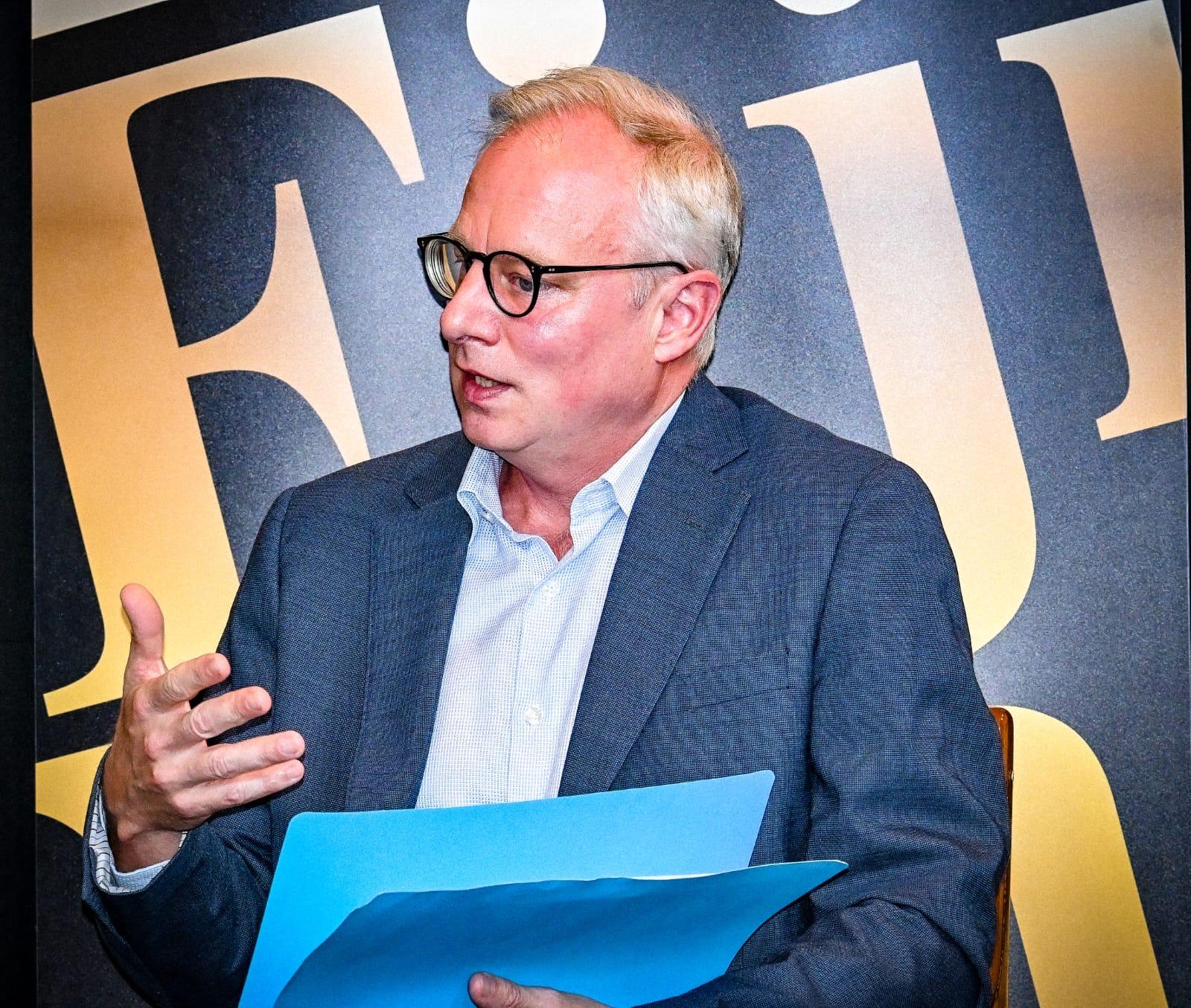
Dr. Marcus Brand. (Photo: International IDEA)
Dr. Marcus Brand is an international expert on institutional reform, constitutional reform and the rule of law, with more than two decades of experience working with the United Nations, OSCE, the European Union (EU) and other international organizations. He holds a doctorate in international and constitutional law and has extensive professional experience across Asia, Europe and the Pacific.
PROMOTED

Russian journalist Alexey Syunnerberg, former Head of the Vietnamese Department, Voice of Russia. From the 60s to the present, he has interviewed and met most of the Vietnamese leaders and politicians when visiting and working in Russia. His whole life he devoted his love and professional activities to Vietnam. He also oriented his only son to become an expert in Vietnamese studies. He considers Vietnam as his second homeland.
WAJ- SAQUILA - ASPIRATION OF VIETNAMESE EAGLE!
- "The power circuit" - To light up national pride - Vietnam Ancestral Global Day project board
- COOPERATION BASED ON GENUINE FRIENDSHIP
- ICI International's meeting on the occasion of the 50th anniversary of diplomatic relations between Austria and Vietnam(1972-2022)



MOST VIEWED
-
1
Golden Autumn Fair 2025: Connecting Trade, Showcasing Excellence, and Elevating Global Products

-
2
Contribution to the Seminar “Compassion the key to Global issues”

-
3
Vienna hosts the Ukraine Peace Support Summit

-
4
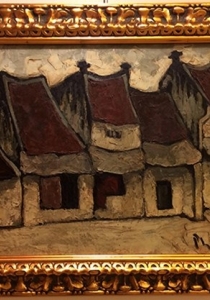
The work "Hanoi Old Quarter" by painter Bui Xuan Phai

-
5
COOPERATION BASED ON GENUINE FRIENDSHIP

The two Kings Philippe and Van der Bellen havedifferent backgrounds, one is of royal origin, and the other is a child of a refugee family (once of noble origin) but now, in the eyes of the European public, both of them are giving off a sense of courtesy, virtue and erudition.
WAJ
With the attendance of many international figures, the 80th anniversary of the end of World War II was celebrated at the United Nations headquarters.
Journalist Usama Soliman


Comment