



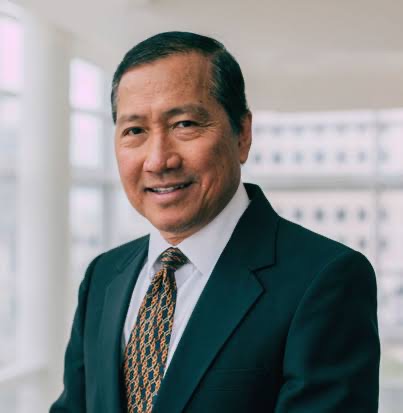
Businessman Michael Vu Nguyen, Country Director of Boeing Vietnam (2021). (Photo: Hoang Tam)
On August 26, 2026, Michael Vu Nguyen, Vice Chairman of FLC Group in charge of aviation and airport infrastructure investment, passed away in Gia Lai at the age of 72. He had held the position for less than a month, after more than four decades devoted to aviation, investment, business development and international cooperation.
Previously, from September 2021, he served as Country Director of Boeing Vietnam, contributing to the expansion of Boeing’s operations, the development of the aviation supply chain, workforce training and connecting Vietnamese businesses with the global aviation industry. He held a number of important positions, including Chairman of AmCham Hanoi, Co-Chair of VBF and Chairman of the U.S.-ASEAN Business Council in Vietnam.
But beyond those titles, perhaps the deepest mark Michael Vu Nguyen left was his role as a bridge connecting Vietnam with the United States and the world, connecting businesses, the Government, investors and opportunities for cooperation.
The conversation below was conducted immediately after he was appointed to his new position. Following his sudden passing, those remarks have become even more special like the final heartfelt words of a man who devoted more than 40 years to building bridges between Vietnam and the world.
“Vietnam and the United States Are Entering a Deeper Phase of Cooperation”
WAJ: Mr. Vu Nguyen, how do you view the prospects for Vietnam-U.S. economic relations in this new phase, particularly after the two countries elevated their relationship to a Comprehensive Strategic Partnership?
Businessman Michael Vu Nguyen: I view the prospects for Vietnam-U.S. economic relations as very positive. The elevation of the relationship between the two countries to a Comprehensive Strategic Partnership in 2023 was not only diplomatically significant, but also created a new framework for expanding cooperation in economics, trade, investment, science and technology, and innovation.
What particularly interests me is that the relationship between the two countries is shifting from a model of cooperation based largely on trade in goods toward a deeper phase of cooperation, in which businesses on both sides participate in global value chains. Vietnam has a tremendous opportunity to become an important link in the development strategies of U.S. businesses in the Asia-Pacific.
But opportunities only become results when Vietnam continues to build a business environment that is transparent, stable, predictable and capable of meeting international standards.
“Don’t Just Sell Into Vietnam; Build an Ecosystem in Vietnam”
WAJ: Which sectors in Vietnam are attracting the greatest interest from U.S. businesses?
Michael Vu Nguyen: I believe there are several prominent sectors.
First is high technology, particularly semiconductors, artificial intelligence, data centers, software and digital services.
Second is industrial manufacturing and supply chains, as many U.S. businesses are looking for locations where they can participate more deeply in regional supply chains.
Third is aviation and logistics. The development of Vietnam’s middle class is creating very strong demand for air transportation, airport infrastructure, technical services and logistics solutions.
There are also opportunities in energy, healthcare, education, financial services and sustainable development solutions.
What is noteworthy is that U.S. businesses are increasingly interested not only in selling products into Vietnam, but also in investing, building capabilities and developing ecosystems in Vietnam. That is a very important change.
Vietnam Can Become an Important Link in the Global Aviation Industry
WAJ: With your many years of experience in aviation, how do you assess Vietnam’s potential in the global aviation supply chain?
Michael Vu Nguyen: I believe Vietnam has significant potential. Vietnam has three major advantages: a growing aviation market, a favorable geographic location in Southeast Asia and a young workforce capable of absorbing technology.
But to become a truly important link in the global aviation supply chain, Vietnam needs to go beyond producing products with low added value. We need to develop capabilities in engineering, design, materials, aviation electronics, maintenance, repair and overhaul, software and specialized technical services.
Boeing has undertaken many activities in Vietnam to support the development of the aviation industry, connect Vietnamese businesses with the supply chain, train human resources and support Vietnam’s deeper integration into the international aviation environment.
I believe that if Vietnam can build an internationally certified supplier ecosystem, the opportunities will not only lie with Boeing but also extend to the global aviation industry as a whole.
This is also one of the reasons I believe aviation can become a much more important industry for Vietnam in the future.
“Four Conditions for Attracting High-Quality Investment Capital”
WAJ: What factors does Vietnam need to improve in order to attract more high-quality investment capital from the United States?
Michael Vu Nguyen: In my view, there are four groups of factors.
First is policy stability and predictability. Long-term investors need to know that important regulations are developed transparently and with clear road maps.
Second is the quality of the workforce, particularly in STEM, engineering, information technology, AI, semiconductors and high-tech industries.
Third is infrastructure, including electricity, logistics, seaports, airports, digital infrastructure and high-quality industrial parks.
Fourth is the domestic business ecosystem. A U.S. corporation can only invest deeply when it can find local partners, suppliers and human resources capable of meeting global standards.
I believe Vietnam is moving in the right direction. What needs to be done next is to continue reforms so that the gap between policy and implementation becomes increasingly narrow.
“The Biggest Challenge Is Not a Lack of Opportunities”
WAJ: In the process of connecting U.S. businesses with Vietnam, what are the biggest challenges you typically encounter?
Michael Vu Nguyen: I think the biggest challenge is not a lack of opportunities, but how to turn opportunities into concrete and sustainable projects.
U.S. businesses pay close attention to transparency, legal regulations, administrative procedures, intellectual property protection, technical standards, data, taxation and the predictability of the business environment.
On the other hand, Vietnamese businesses sometimes do not fully understand how U.S. corporations select partners, manage risk and control quality.
Therefore, it is important to help both sides understand each other better. It is not only about connecting businesses with businesses, but also about creating understanding between businesses and regulatory agencies and among business ecosystems.
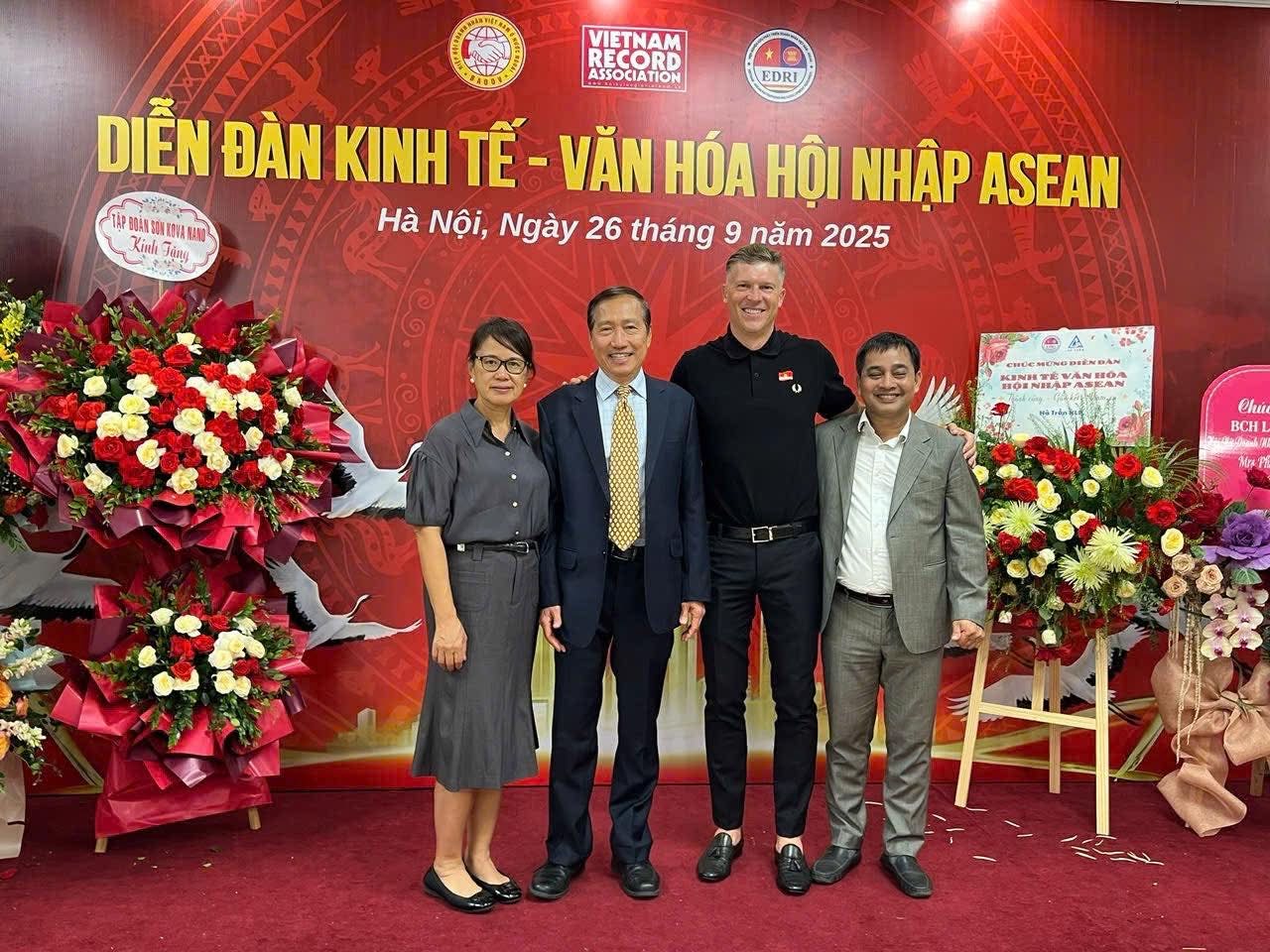
Businessman Michael Vu Nguyen (second from left) and his wife with partners at an economic forum. (Photo: Hoang Tam)
Vietnamese Overseas Entrepreneurs Can Bring Back More Than Capital
WAJ: How do you assess the role of the Vietnamese business community in the United States in promoting economic and trade relations and technology transfer between the two countries?
Michael Vu Nguyen: I believe the role of the Vietnamese overseas business community in the United States is very special.
They have an advantage that not every community possesses: they understand Vietnam while also understanding how the U.S. market operates.
They can serve as bridges in language, culture, management, technology, capital and business networks.
I particularly hope that the younger generation of Vietnamese overseas entrepreneurs will bring back not only capital to Vietnam, but also knowledge, technology, management standards and international networks. If we can connect the resources of this community with Vietnam’s development needs, we will create tremendous value for both economies.
“Reputation Is What Creates Lasting Relationships”
WAJ: What would you like to say to the younger generation of Vietnamese entrepreneurs who want to cooperate with major U.S. corporations?
Michael Vu Nguyen: The first thing is a global mindset. Vietnamese businesses cannot compete on price alone. To become partners of major U.S. corporations, businesses must demonstrate quality, delivery capabilities, risk management, data security, legal compliance and social responsibility.
Second is foreign-language proficiency and the ability to communicate internationally.
Third is technological capability.
And finally, I believe reputation is very important.
In international business, a contract can generate revenue, but reputation is what creates lasting relationships. I want to encourage young Vietnamese entrepreneurs to think bigger than the Vietnamese market and set the goal of becoming suppliers to the global market.
“Technology and Aviation Will Jointly Drive the Digital Economy”
WAJ: How do you view the role of U.S. technology and aviation companies in the development of Vietnam’s digital economy?
Michael Vu Nguyen: Technology and aviation are very closely connected to the digital transformation process.
A modern aviation industry needs more than aircraft. It needs data, AI, cybersecurity, air traffic management, airport operations optimization, smart logistics and digital platforms.
These are also areas in which U.S. technology companies have strong capabilities. Vietnam can leverage cooperation with U.S. companies to develop technological infrastructure, train human resources and establish international standards.
But the ultimate goal should not simply be to use technology. Vietnam needs to gradually participate in the process of creating and developing technology.
Vietnam Has an Opportunity in the Restructuring of Global Supply Chains
WAJ: Against the backdrop of geopolitical competition and the restructuring of global supply chains, what advantages does Vietnam have to become a strategic destination for U.S. businesses?
Michael Vu Nguyen: Vietnam has several clear advantages.
First is its strategic geographic location in Southeast Asia.
Second is its network of trade agreements and its ability to connect with major markets.
Third is its young and increasingly skilled workforce.
Fourth is its sizeable domestic market and growing middle class.
But the most important advantage, in my view, is stability and the ability to build long-term cooperative relationships.
Against the backdrop of global businesses seeking to diversify their supply chains, Vietnam has a very good opportunity. However, Vietnam needs to demonstrate that it is not merely a place with competitive costs, but a place capable of providing quality, technology, reliability and long-term development.
“Come to Vietnam, but Don’t Just See Vietnam as a Market”
WAJ: If you could send one message to U.S. investors considering investing in Vietnam, what would you say?
Michael Vu Nguyen: I would say: “Come to Vietnam, but don’t just see Vietnam as a market. See Vietnam as a long-term partner.”
Vietnam is changing very rapidly. There are challenges, but the opportunities are also very great. Any U.S. investor with a long-term vision, willing to invest in people, technology, local partnerships and ecosystem development, will have many opportunities to succeed.
I also want to emphasize that successful investment is not about seeking short-term benefits. It is a process of growing together with Vietnam. I believe Vietnam needs U.S. businesses, and U.S. businesses also need Vietnam in the process of restructuring their supply chains and expanding their markets in Asia.
“The Most Interesting Part of the Vietnam-U.S. Relationship May Still Lie Ahead”
WAJ: From a personal perspective, what has kept you committed to and devoted to promoting Vietnam-U.S. economic cooperation?
Michael Vu Nguyen: Perhaps what has kept me most committed is that I have had the opportunity to witness Vietnam’s transformation over many years.
I have had the opportunity to work in many fields and in many countries. But Vietnam has something very special: a rapid pace of change, an energetic younger generation and a tremendous aspiration to move forward.
I believe the Vietnam-U.S. relationship has gone through a very proud journey. From a time when the two countries once had a very difficult history, today we have become Comprehensive Strategic Partners.
For me, contributing to Vietnam-U.S. relations is not only about business. It is also about building bridges between people and people, between businesses and businesses, and between the two economies.
If we can create more opportunities for Vietnam’s younger generation, help Vietnamese businesses enter global value chains and help U.S. businesses better understand Vietnam, I think that is a meaningful contribution.
I believe the road ahead for Vietnam-U.S. relations is still very long, and the most interesting part may still lie ahead.
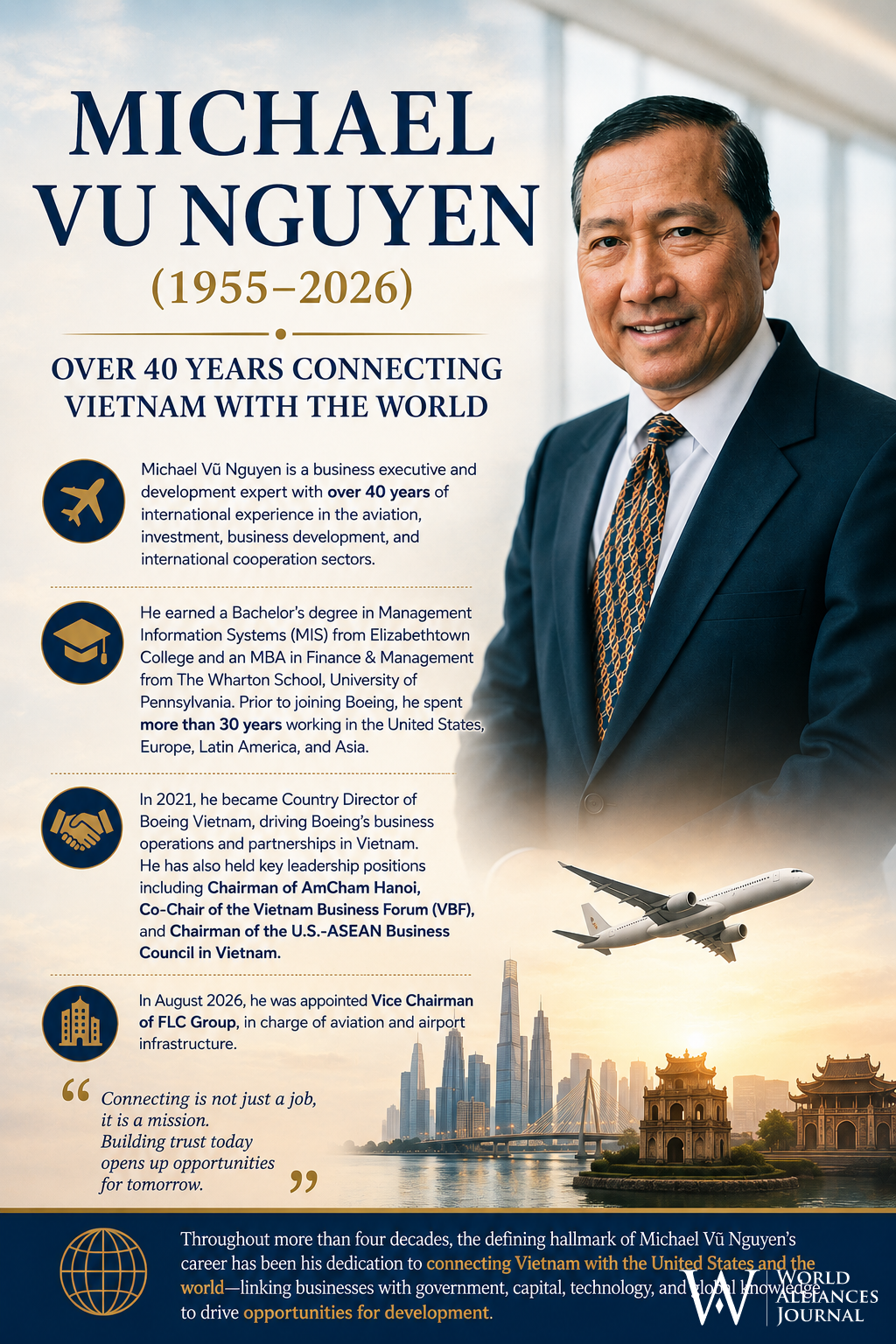
Businessman Michael Vu Nguyen - the person who connected Vietnam and the world for more than 40 years in the economic field. (Photo: Hoang Tam, AI/WAJ)
The Legacy of a Connector
Some people are remembered for the positions they once held.
Some people are remembered for the deals they once carried out.
And some people are remembered for the bridges they built.
Michael Vu Nguyen belonged to the third group.
More than 40 years of working in an international environment took him across many fields and many markets. Before joining Boeing, he had more than 30 years of experience in aviation, healthcare, education and manufacturing in the United States, Europe, Latin America and Asia. He held a bachelor’s degree in Management Information Systems from Elizabethtown College and an MBA in Finance & Management from The Wharton School, University of Pennsylvania.
At Boeing Vietnam, he did not focus only on the business operations of a global aviation corporation. According to his AmCham profile, he was also responsible for promoting Boeing’s presence, developing the aviation supply-chain network, government relations, education and social responsibility programs.
Within the business community, he participated in many dialogue and networking mechanisms.
His roles as Chairman of AmCham Hanoi, Co-Chair of VBF and Chairman of the U.S.-ASEAN Business Council in Vietnam placed him in a special position: he understood international business while also understanding Vietnam.
Perhaps that is why, in his remarks, the words that appeared most often were not “profit,” but connection, capability, trust and the long term.
He once said that Vietnamese businesses seeking to enter global value chains must demonstrate quality, delivery capabilities, risk management, data security, legal compliance and social responsibility. But behind those seemingly technical requirements was a larger message: if Vietnam wants to go further in global value chains, it must build international trust.
His final days remained connected to aviation - the field to which he devoted most of his career. Before officially joining FLC, he helped connect FLC with HAS Development Corporation of the United States in a plan to study investment in and the upgrading of Phu Cat and Pleiku airports. The media also reported that FLC appointed him Vice Chairman in charge of aviation and airport infrastructure effective August 1, 2026, just weeks before his passing.
Michael Vu Nguyen’s sudden passing therefore leaves a void not only in a business or an economic sector.
But the things he pursued may continue to be remembered: a Vietnam capable of participating more deeply in global value chains; a Vietnamese overseas business community bringing back not only capital but also knowledge and international networks; Vietnamese businesses competing through quality and reputation; and a Vietnam-U.S. relationship built on trust, mutual benefit and a long-term vision.
And perhaps the most fitting words with which to close this conversation are also the message that Michael Vu Nguyen once gave to U.S. investors: “Come to Vietnam, but don’t just see Vietnam as a market. See Vietnam as a long-term partner.”
It is not merely an invitation to invest. It is a way of looking at Vietnam’s future.
Conducted by
Dr. Yen Platz (WAJ Representative to the United Nations – Vienna, Austria)
M.A. Hoang Tam (Vietnam)
PROMOTED
In the 70s of the last century, the young Heinz Fischer once took to the streets to protest, against the American war in Vietnam, now he has become the President of the Republic of Austria. On the occasion of the 40th anniversary of the establishment of diplomatic relations between Austria and Vietnam (1972-2012), the President of Austria will pay a state visit to Vietnam from May 29 to 31, 2012.
WAJ



MOST VIEWED
-
1
New Belgian Ambassador presents credentials, begins his term in Vietnam

-
2
Director General's Statement to the 68th IAEA General Conference

-
3
A high-ranking Vietnamese academic delegation is researching in Vienna to develop university education

-
4
Vietnam Culture Show in the UK

-
5
A unique educational experience.. Reading a story to children in four languages


The two Kings Philippe and Van der Bellen havedifferent backgrounds, one is of royal origin, and the other is a child of a refugee family (once of noble origin) but now, in the eyes of the European public, both of them are giving off a sense of courtesy, virtue and erudition.
WAJ
With the attendance of many international figures, the 80th anniversary of the end of World War II was celebrated at the United Nations headquarters.
Journalist Usama Soliman



Comment