



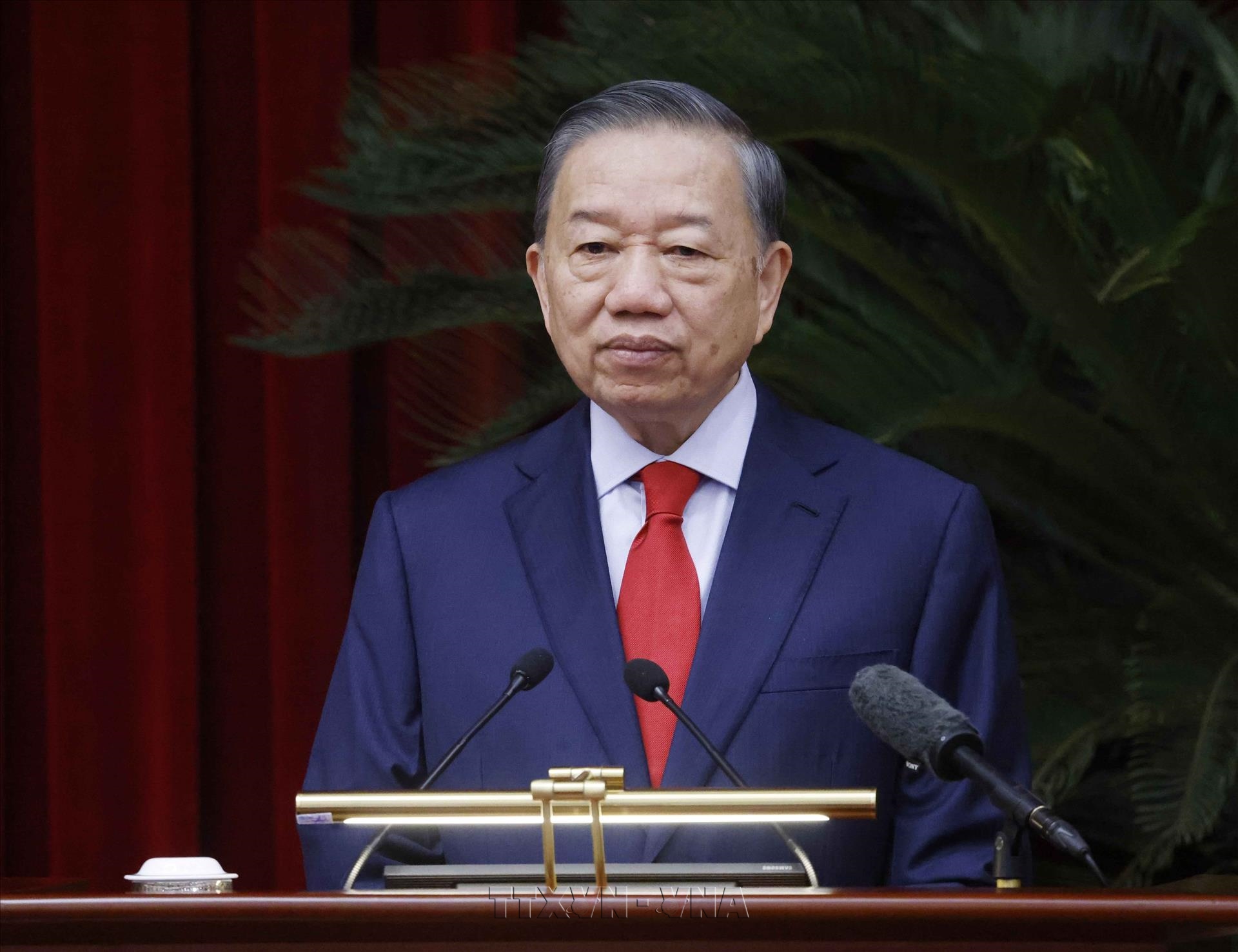
General Secretary of the Communist Party of Viet Nam Central Committee and President To Lam. (Photo: VNA)
At the centre of this transition is General Secretary and President To Lam. He has described the road ahead as a “new era of development – an era of the Vietnamese nation’s rise.” Behind this symbolic phrase is an ambitious agenda: accelerating economic growth, reforming the state apparatus, removing institutional bottlenecks, placing science, technology and innovation at the heart of the development model, and expanding Vietnam’s scope for international engagement.
Putting Results at the Centre
To outside observers, one of the most distinctive features of To Lam’s leadership style is his emphasis on action and results. His speeches frequently invoke implementation, removing obstacles, innovation and accountability. His call to “say it and do it, act immediately, act correctly, act decisively, see it through and deliver results” encapsulates this approach to governance.
Behind that message is a challenge that extends well beyond Vietnam: how to close the gap between ambitious strategies drawn up at the central level and tangible improvements in the economy, public administration and people’s daily lives. For To Lam, the answer lies in the capacity to implement policy: a policy has real value only when it produces visible, measurable results.
This approach also helps explain the resolve behind Vietnam’s development agenda. Hanoi is seeking not only faster growth but also new drivers of growth. Science and technology, digital transformation, artificial intelligence, innovation and a highly skilled workforce are central to the country’s development strategy.
It also offers a glimpse of the model of a 21st-century communist leader that To Lam may be seeking to embody: steadfast in his objectives yet pragmatic in his actions; committed to the core values of independence, development and social progress while adapting proactively to the technological, economic and geopolitical changes reshaping the world. From this perspective, innovation does not mean abandoning established principles. It means finding new ways to keep them relevant and vital in a changing era.
The Figures – and the Questions Behind Growth
Vietnam’s economy grew by 8.02% in 2025, with GDP per capita reaching US$5,026. Growth remained strong at 9.01% in the first nine months of 2026, while international trade continued to expand and foreign investment remained an important contributor.
These figures help explain some of the growing confidence evident in Hanoi’s political discourse. Yet To Lam’s vision extends beyond the sheer size of the economy. As he has repeatedly argued, a larger economy must ultimately mean better lives for people, through employment, education, healthcare, social protection and wider opportunities.
Here, Vietnam’s growth story intersects with a familiar principle of the communist movement: economic development is not an end in itself. Its ultimate value lies in what it delivers for people. The “era of the Vietnamese nation’s rise” envisaged by Hanoi will therefore not be judged by rising GDP figures alone. The harder test will be whether rapid growth can improve living standards, narrow development gaps and ensure that the benefits of modernisation are widely shared.
A More Confident Vietnam on the World Stage
This shift is also evident in how Vietnam engages with the world. Under To Lam’s leadership, foreign policy is increasingly tied directly to national development. International relations are expected not only to preserve a peaceful environment but also to open up access to technology, investment, knowledge, markets and new resources. At the same time, in an increasingly polarised world, Hanoi continues to uphold principles long associated with Vietnamese diplomacy: independence, autonomy, and the multilateralisation and diversification of external relations.
Striking this balance is far from simple. Vietnam wants to deepen ties with major powers without being drawn into choosing sides. It seeks closer integration into the global economy while retaining the ability to make its own strategic decisions. In other words, Vietnam wants to open its door wider to the world while keeping its own hand on the handle. This balancing act is helping Hanoi establish a more prominent position as the international balance of power shifts.
The Answer Is Still Being Written
The road ahead for To Lam will not be smooth. Vietnam continues to face challenges in productivity, the quality of growth, institutional reform, human resources and competitiveness in a world of unprecedented technological change. A country determined to move faster must also confront the question of how to ensure that no one is left behind.
Perhaps the most striking feature of To Lam’s message, then, is not a promise of an easy future but a sense of urgency: Vietnam has a historic opportunity and does not want to let it pass.
Over nearly a century, successive generations of Vietnamese leaders have faced different questions posed by history. Ho Chi Minh’s generation, associated with the founding of the modern Vietnamese state, confronted the struggle for independence. The Doi Moi generation sought a way out of poverty and stagnation and towards greater openness to the world. The question facing To Lam and today’s leadership is different: how can a Vietnam that has secured independence and reunification and achieved the successes of Doi Moi become a developed, prosperous country with greater influence in the world?
The answer is still being written.
Yet from new roads and factories to emerging technology hubs and Vietnam’s increasingly confident presence at international forums, there is a palpable sense of a country in motion. At the centre of that movement is To Lam, a leader seeking to turn aspiration into action and decades of accumulated achievements into a springboard for a new chapter in Vietnam’s development.
PROMOTED
On 3rd Nov, the Christian Democratic Union (CDU) recently held a Party Congress to elect a new manager at the Ferienpark Bodetal hall in Thale, Germany. Nguyen Dac Nghiep, a Vietnamese MP, has been officially elected Vice Chairman of the Party.
WAJ



MOST VIEWED
-
1
Kofi Annan Award 2022

-
2
On the first day of spring, Vietnamese from all continents returned to Hung Temple

-
3
ICI International's meeting on the occasion of the 50th anniversary of diplomatic relations between Austria and Vietnam(1972-2022)

-
4
Australia supports carbon markets partnerships in Vietnam

-
5
UN asks Member States to Increase ODA Funding

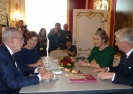
The two Kings Philippe and Van der Bellen havedifferent backgrounds, one is of royal origin, and the other is a child of a refugee family (once of noble origin) but now, in the eyes of the European public, both of them are giving off a sense of courtesy, virtue and erudition.
WAJ
With the attendance of many international figures, the 80th anniversary of the end of World War II was celebrated at the United Nations headquarters.
Journalist Usama Soliman



Comment