





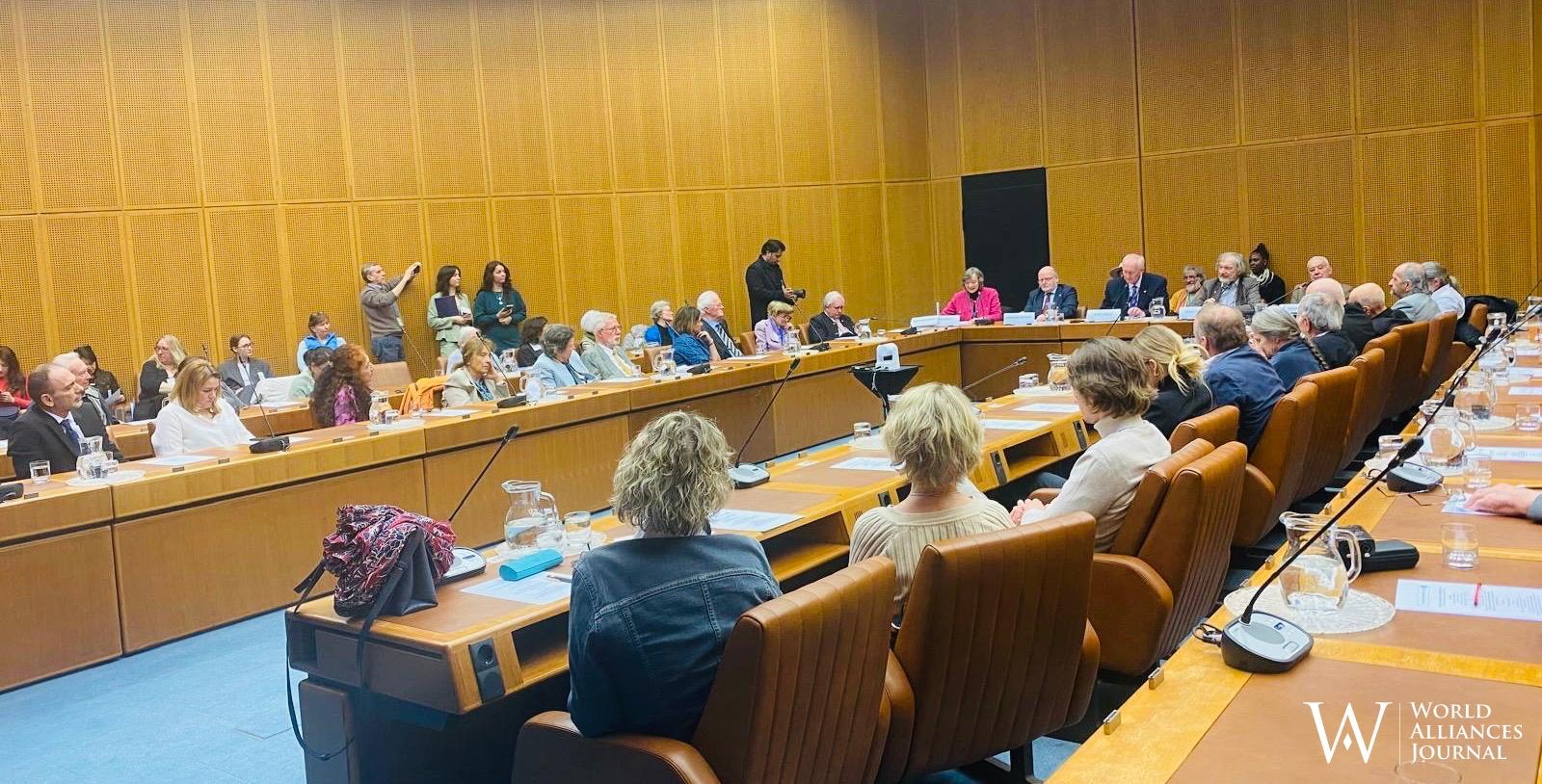
One of the important events organized in coordination by the NGO Committee on Peace – Vienna at the United Nations Office in Vienna. (Photo: WAJ)
On December 5, diplomats, scholars and civil society representatives are expected to meet at the Vienna International Centre to examine the Accords’ legacy at a moment when Europe faces profound security challenges not seen since the Cold War.
A Legacy — and Open Questions
The Helsinki Accords established three pillars: security, economic and scientific cooperation, and human rights. These principles expanded East–West dialogue and helped shape political transformations across Eastern Europe. Fifty years on, they are being re-examined in a drastically altered geopolitical landscape.
Analysts Look Ahead: Is a “Helsinki 2.0” Needed?
Speakers are expected to ask how the Accords’ principles — designed for an era of ideological confrontation — can be adapted to modern threats such as cyberwarfare, disinformation and technological rivalry. Some argue it may be time to imagine a “Helsinki 2.0.”
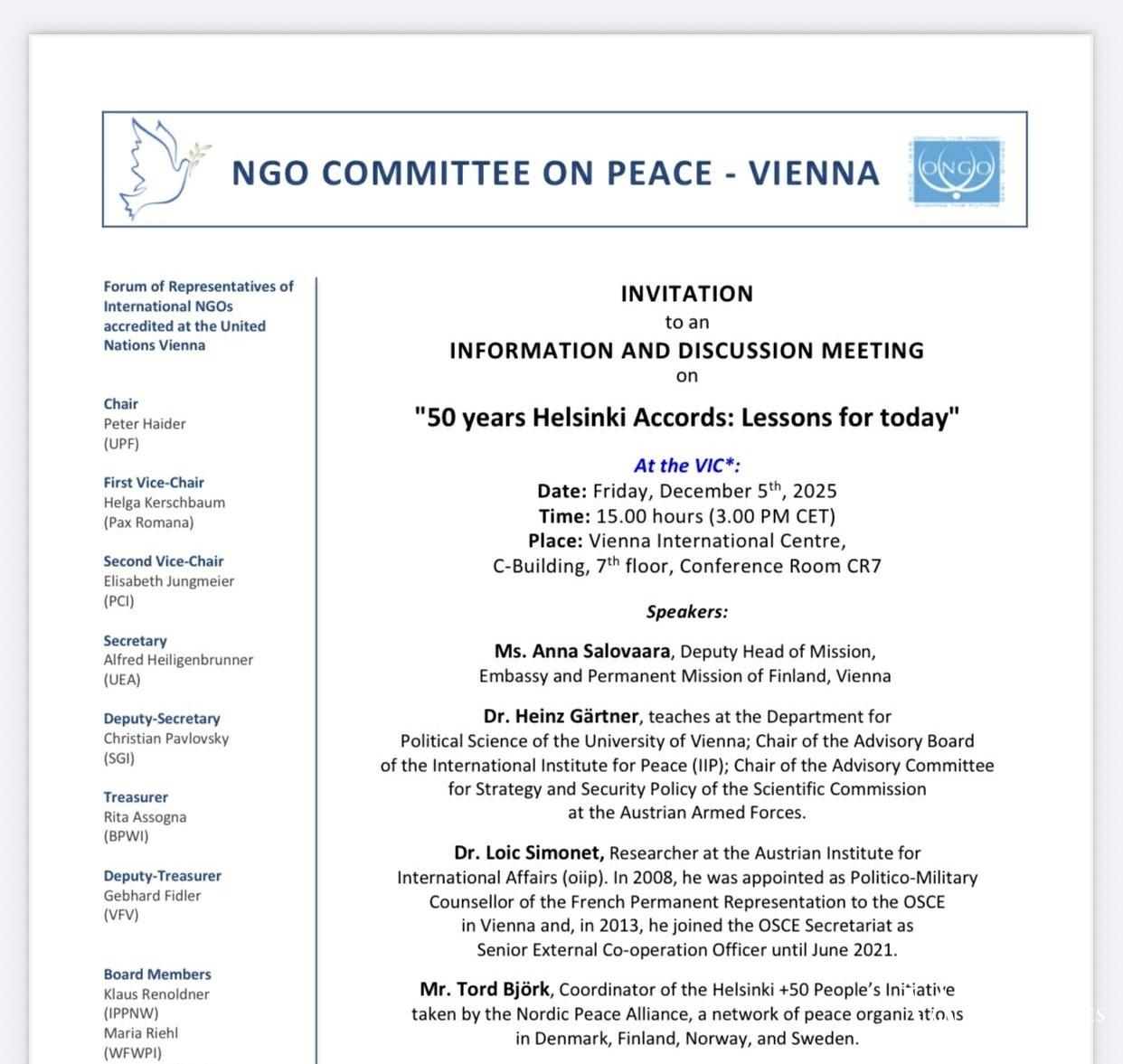
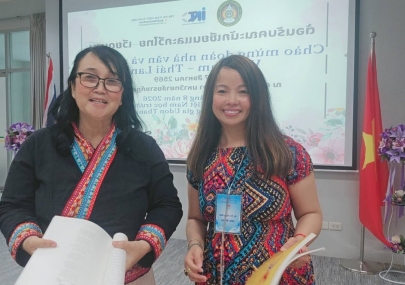
Invitation: '50 Years of the Helsinki Accords: Lessons for Today``. ("Photo: WAJ)
The Role of Civil Society
With the NGO Committee on Peace – Vienna co-hosting the event, the gathering highlights the importance of civil society in sustaining dialogue and protecting human rights — the forces that once propelled the “Helsinki spirit.” As multilateral institutions strain, observers ask whether NGOs can fill the gaps.
A Moment to Consider Europe’s Security Future
Though the discussion has not yet taken place, many view it as a crucial test of whether principles forged half a century ago can be renewed for the 21st century — and whether the Helsinki spirit can endure in a Europe marked by deepening geopolitical fractures.
PROMOTED
“Refugees need to be taken care of. I do not turn my back on those who have concerns and fears, but I turn my back on those who profit economically or politically from the suffering of refugees,” said Austrian President Heinz Fischer.
Dr. Yen Platz

MOST VIEWED
-
1
Vietnam Taekwondo will conduct long-term training in France for Olympics 2024 in Paris
-
2
The “group” and the united nations convention against corruption

-
3
Artificial Intelligence in Medicine is the Focus of the European Respiratory Society Conference

-
4
INTENATIONAL FORUM: MOSAICS OF THE KING

-
5
ODIHR opens election observation mission in Bosnia and Herzegovina


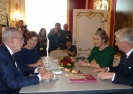
The two Kings Philippe and Van der Bellen havedifferent backgrounds, one is of royal origin, and the other is a child of a refugee family (once of noble origin) but now, in the eyes of the European public, both of them are giving off a sense of courtesy, virtue and erudition.
WAJ
With the attendance of many international figures, the 80th anniversary of the end of World War II was celebrated at the United Nations headquarters.
Journalist Usama Soliman
Comment