





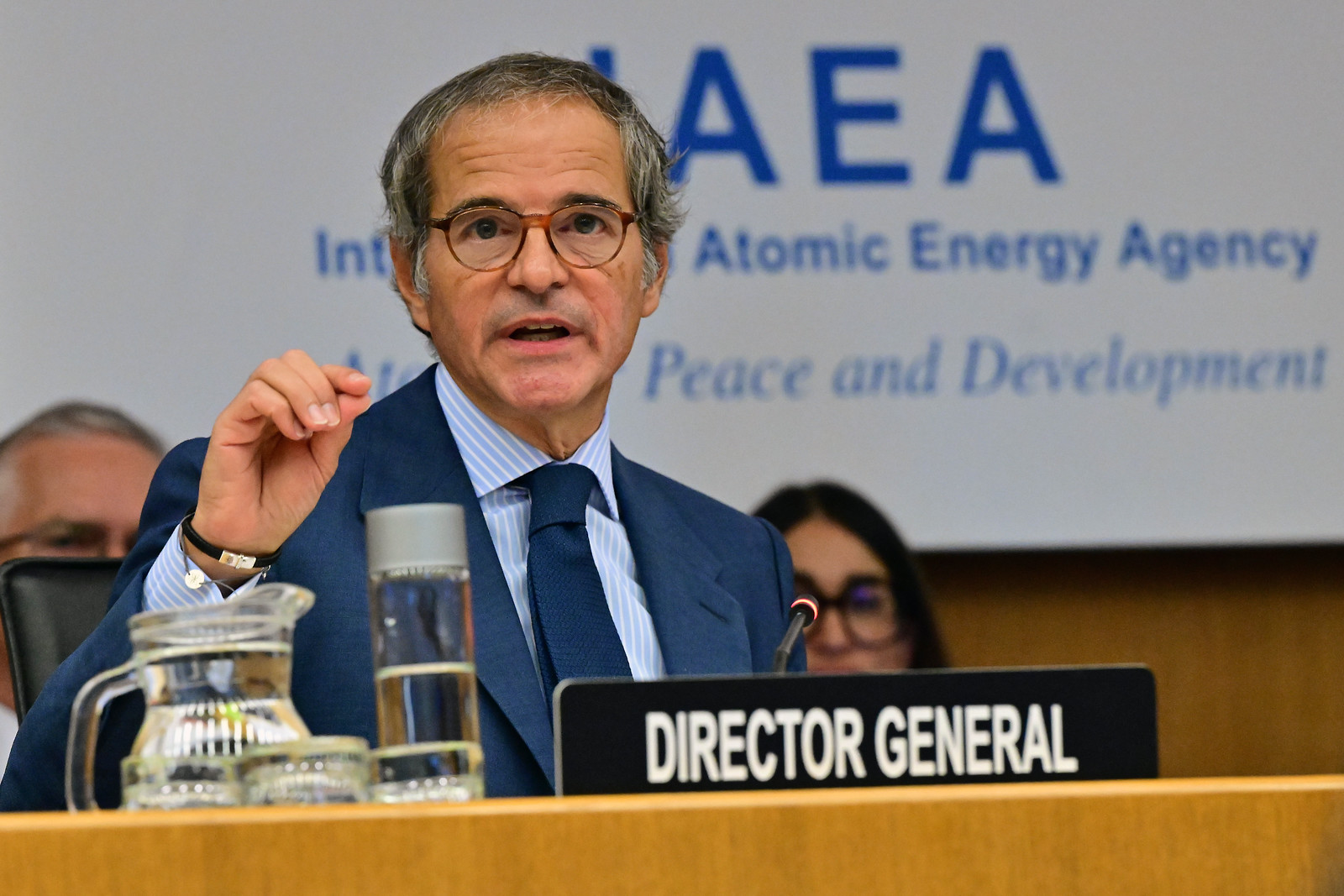
Rafael Mariano Grossi, IAEA Director General, delivers his remarks at the opening of the 1816th Board of Governors meeting held at the Agency headquarters in Vienna, Austria. 7 September 2026 (Photo Credit: Dean Calma / IAEA)
International Atomic Energy Agency Director General Rafael Mariano Grossi used his opening statement to the IAEA Board of Governors to outline a wide range of nuclear safety, security, safeguards and development issues facing the Agency. His remarks came as the international nuclear environment remains marked by armed conflict, unresolved verification questions and renewed interest in nuclear energy and advanced nuclear technologies.
Grossi’s statement covered developments in Syria, Ukraine, Iran and the Democratic People’s Republic of Korea, while also addressing nuclear safety in other parts of the world, the peaceful uses of nuclear technology, the expansion of nuclear power and the need to strengthen international cooperation. Across these areas, he emphasized the importance of reliable verification, technical cooperation and continued engagement among IAEA Member States.
Syria: A Breakthrough in Resolving Long-Standing Nuclear Safeguards Questions
Grossi highlighted what he described as a historic breakthrough in the implementation of nuclear safeguards in Syria. The development follows increased cooperation between the IAEA and Syria’s new government, which agreed to provide the Agency with information and access to the Dair Alzour site and other locations in the country. The site has long been at the centre of international questions after the IAEA previously assessed that a building destroyed there in 2007 was very likely a nuclear reactor under construction that Syria was required to declare under its NPT Safeguards Agreement.
According to Grossi, the Syrian authorities have now provided the necessary access and information, enabling the Agency to evaluate safeguards-relevant material and address outstanding questions concerning Syria’s past nuclear activities. He welcomed Syria’s cooperation and said the information provided had allowed the Agency to make progress on issues that had remained unresolved for many years.
The Agency’s findings include information concerning previously undeclared nuclear material and the Dair Alzour site. Grossi said the material and findings were consistent with the Agency’s earlier assessment that a gas-cooled, graphite-moderated nuclear reactor had been under construction there under Syria’s previous government. Syria also submitted a design information questionnaire on 27 August 2026 identifying the installation as a decommissioned reactor, while excavation work at the site continues to be monitored by the Agency.
Ukraine: Continuing Power Losses Keep the Zaporizhzhya Nuclear Plant at Risk
Grossi devoted considerable attention to the nuclear safety situation at the Zaporizhzhya Nuclear Power Plant, where reliable electricity supplies remain essential to critical safety and security systems. The plant’s six reactors and spent fuel pools depend on cooling systems powered by electricity, making the stability of the external power supply a central concern for nuclear safety. Since June, the plant has experienced 10 losses of off-site power, bringing the total number of such incidents since the beginning of the conflict to 26.
The repeated interruptions have increased the plant’s dependence on emergency diesel generators. Since 20 August, those generators have been supplying power after military activity north of the Dnipro River severed the connection to the 330-kilovolt Ferosplavna-1 power line. With diesel reserves falling to little more than a week of supplies, Grossi said he continued efforts to broker a localized ceasefire that would allow the damaged line to be repaired.
A seventh ceasefire took effect over the weekend, allowing demining and repair work to begin. Grossi said both sides had worked constructively with the IAEA to make the arrangement possible, demonstrating that practical measures to reduce nuclear risks can still be achieved despite the wider military situation. IAEA teams remain on the ground monitoring the demining and repair operations.
The plant’s second external power line, the 750-kilovolt Dniprovska line, was repaired in June under an earlier ceasefire arrangement negotiated with the Agency. However, it remains unavailable because severe damage to the associated Dniprovska substation has prevented it from returning to service. Grossi also raised concern over the safety of plant personnel following a drone explosion last month at a bus stop used by staff and subcontractors travelling to the facility. The plant reported 20 casualties, including one death and three serious injuries.
Grossi called on military commanders in the region to stop attacks on nuclear facilities and their personnel and to exercise maximum restraint. He stressed that protecting nuclear workers and maintaining essential safety functions must remain a priority regardless of the wider military situation.
The IAEA’s continuing presence in Ukraine remains a major part of those efforts. Since the beginning of its continuous presence there, 185 IAEA staff members have taken part in 287 missions, representing 645 person-months of work. The Agency has also delivered more than 250 shipments of equipment to Ukraine, worth more than €27 million, covering nuclear safety and security equipment, power supplies, radiation monitoring instruments, physical protection equipment and medical assistance.
Nuclear Safety Beyond Ukraine: From Fukushima Monitoring to International Preparedness
Grossi stressed that nuclear risks associated with armed conflict are not confined to Ukraine. The IAEA’s Incident and Emergency Centre in Vienna continues to operate around the clock, monitoring developments in different regions, including the Gulf, while maintaining contact with relevant national authorities. According to information reported to the Agency, radiation levels in the Gulf region remained at normal background levels at the time of his statement.
He reiterated the broader principle underpinning the Agency’s nuclear safety work: nuclear safety applies universally and cannot depend on geography or political circumstances. From protecting nuclear plants during armed conflict to emergency preparedness and international monitoring, Grossi emphasized that the consequences of a nuclear accident would extend beyond national borders.
The Agency is also continuing its independent monitoring of Japan’s discharge of ALPS-treated water from the Fukushima Daiichi Nuclear Power Station. Japan has begun the twenty-third batch of the discharge, with more than 170,000 cubic metres released since operations began. Grossi said the tritium concentrations reported to the Agency remained far below Japan’s operational limit and consistent with international safety standards.
The IAEA is conducting six independent sampling and analysis campaigns each year under its Additional Measures framework. Scientists from the Agency, the ALMERA network and Japan participate, with experts from China, the Republic of Korea and the Russian Federation also involved. Grossi said this approach turns international laboratories into co-producers of data, rather than simply recipients of information, and described such transparency as important to maintaining confidence in nuclear safety.
Iran: Grossi Calls for Diplomacy as Verification Gaps Persist
Iran remains another major challenge for the international nuclear non-proliferation system. Grossi said the IAEA has been unable to verify the status of certain nuclear material and facilities, leaving gaps in the Agency’s knowledge regarding Iran’s previously declared inventories of low-enriched uranium and uranium enriched up to 60 percent uranium-235 at facilities affected by military attacks in June 2025.
More than a year after the Agency lost continuity of knowledge concerning those inventories, Grossi described the lack of information and the inability to conduct verification activities as a serious proliferation concern. He called on Iran to cooperate constructively with the IAEA so that comprehensive safeguards can be implemented effectively and the country can meet its obligations under its safeguards agreement.
At the same time, Grossi emphasized that diplomacy remains essential to resolving the wider dispute. He said a return to negotiations aimed at addressing the outstanding issues surrounding Iran’s nuclear programme was imperative and stressed that the IAEA was prepared to support such efforts. For the Agency, the issue extends beyond immediate questions of verification, because developments concerning Iran also have wider implications for the international non-proliferation regime.
“A return to diplomacy and negotiations aimed at finding a solution to issues related to Iran’s nuclear programme is imperative,” Grossi said.
North Korea: IAEA Monitors Signs of Further Nuclear Development
Grossi also expressed serious concern over developments in the Democratic People’s Republic of Korea’s nuclear programme. The IAEA continues to monitor activities at Yongbyon and has observed a new building whose dimensions and infrastructure are similar to those associated with the Kangson enrichment facility. Photographs taken in June appeared to show centrifuges of the same type as those previously depicted in images of DPRK enrichment facilities.
The Agency has also observed indications that the 5MW(e) reactor at Yongbyon is likely continuing its seventh irradiation cycle, while a light-water reactor appears to have resumed operation after a period of shutdown. Grossi said the continued operation of enrichment facilities at Kangson and Yongbyon, together with reported expansion of the country’s production of weapons-grade nuclear material, remains a cause for serious concern.
The IAEA regards the continuation and further development of North Korea’s nuclear programme as violations of relevant United Nations Security Council resolutions. Grossi said the Agency continues to maintain an enhanced readiness to play its role in verifying the DPRK’s nuclear programme should circumstances allow it to do so.
Nuclear Energy: Rising Demand Brings New Questions on Financing, Technology and Safety
Beyond the immediate security challenges, Grossi presented nuclear energy as an area of expanding international interest. According to the figures cited in his statement, 417 nuclear power reactors are operating in 31 countries, representing more than 379 gigawatts of installed capacity and around 9 percent of global electricity generation. Another 78 reactors, with more than 81 gigawatts of capacity, are under construction in 17 countries, including three countries building nuclear power reactors for the first time.
The IAEA is supporting 43 countries that are considering or beginning nuclear power programmes through its Milestones Approach, while another 20 countries are considering nuclear power. Grossi linked the renewed interest in nuclear energy to growing electricity demand, energy security and sustainable development, while stressing that the expansion of nuclear capacity must continue to be accompanied by strong safety, security and regulatory frameworks.
One of the principal obstacles for emerging and developing economies is access to financing. Grossi highlighted the IAEA’s growing cooperation with the World Bank Group and other international financial institutions, including efforts to help financial institutions better understand nuclear power programmes, infrastructure requirements, regulatory frameworks and investment considerations. The Agency is seeking to move beyond high-level dialogue toward practical cooperation and capacity building that could ultimately widen financing options for countries choosing nuclear energy.
The Agency is also preparing for developments in advanced nuclear technology. Its Nuclear Harmonization and Standardization Initiative continues to work toward the safe and timely deployment of small modular reactors and other advanced reactor technologies. Grossi also highlighted efforts to extend the operating lifetimes of existing nuclear fleets, reflecting the importance of maintaining reliable energy supplies while ensuring long-term safety and efficiency.
Nuclear Technology at Sea: IAEA Launches ATLAS Initiative
Another emerging area is the potential use of nuclear technology in maritime applications. In August, Grossi launched ATLAS — Atomic Technologies Licensed for Applications at Sea — in Washington, D.C., with the United States as host. The event brought together 650 participants from IAEA Member States, industry, non-governmental organizations and other stakeholders to examine the prospects for peaceful nuclear applications at sea.
The initiative seeks to bring the nuclear and maritime sectors closer together as technologies such as floating nuclear power plants and nuclear-powered ships attract growing international interest. In cooperation with the International Maritime Organization, the IAEA plans to develop a framework supporting the safe and secure development and deployment of these technologies while addressing legal, regulatory and licensing questions.
Grossi presented the initiative as part of the Agency’s broader effort to ensure that emerging nuclear technologies develop within appropriate international safety, security and safeguards frameworks. The Agency also expects ATLAS to strengthen its ability to implement safeguards for peaceful nuclear applications at sea as the technology develops.
Cancer Care and the Peaceful Uses of Nuclear Science
Grossi also used his statement to emphasize the IAEA’s role beyond nuclear security, particularly in health and development. Through its technical cooperation and scientific programmes, the Agency supports Member States in applying nuclear technology to cancer diagnosis and treatment, food and agriculture, water resources, environmental monitoring and other areas of sustainable development.
The Agency’s Rays of Hope initiative is part of this broader effort to expand access to cancer care. Grossi highlighted the programme as an example of how nuclear science can directly contribute to human health, particularly in countries where access to specialized cancer diagnosis and treatment remains limited.
For Grossi, these programmes demonstrate that the work of the IAEA cannot be viewed only through the lens of nuclear proliferation or security. The peaceful uses of nuclear technology form another major part of the Agency’s mandate, linking nuclear science with public health, food security, environmental protection and economic development.
Building the Next Generation of Nuclear Expertise
Grossi also drew attention to the importance of developing the international nuclear workforce. The Marie Sklodowska-Curie Fellowship Programme, he said, has selected 860 students from 135 Member States across six application cycles. Of the 561 graduates, 236 have obtained IAEA-facilitated internships, while others have continued into doctoral studies or employment in the nuclear field. The seventh call for applications opened on 1 September.
The Lise Meitner Programme has likewise expanded professional opportunities through international visits and training. Since 2023, the programme has organized eight visits hosted by seven Member States, reaching 115 professionals from 49 countries. Its latest programme, held in August 2026, covered subjects ranging from the nuclear power lifecycle and fuel cycle to safety, security, safeguards and research and development.
For Grossi, such programmes are part of the long-term infrastructure required to ensure that countries can safely benefit from nuclear science and technology. He called for additional support and hosts so that these programmes can continue expanding in the coming years.
A Broader Role for the IAEA in a Fragmented International System
Taken together, Grossi’s statement presented an IAEA operating across an unusually broad range of international challenges. Its responsibilities extend from verifying nuclear activities in countries such as Iran and North Korea to helping protect nuclear facilities during armed conflict, monitoring environmental safety, supporting the development of nuclear power and preparing international frameworks for emerging technologies.
He also addressed the Agency’s own financial position. Although several large payments since the June Board meeting had improved its liquidity, Grossi warned that the Agency’s financial stability and continuity of operations depend on Member States paying their assessed contributions on time. He urged countries with outstanding 2026 contributions to settle them as soon as possible.
The breadth of the statement ultimately returned to the central message with which Grossi opened his remarks: the IAEA’s role has become more important as international relations become more fragmented and nuclear risks become more interconnected. Its work now encompasses not only safeguards and non-proliferation, but also nuclear safety, energy security, climate policy, health, scientific development and international cooperation.
“In a fragmented world, the IAEA is more indispensable than ever,” Grossi said.
His closing message was focused on the Agency’s role in navigating an increasingly uncertain international environment. At a time of conflict and geopolitical fragmentation, Grossi said, the pursuit of peace, security and development requires continued engagement and support from the international community.
By Yen Platz | Vienna
Photo Credit: Dean Calma / IAEA
Full statement: https://www.iaea.org/newscenter/statements/iaea-director-generals-introductory-statement-to-the-board-of-governors-7-september-2026
PROMOTED


- Prof.Dang Ngoc Long - Aspiration to Spread Vietnamese Music Worldwide
- Minister Luong Tam Quang: Solidarity - Nobility - Humanity - Together to protect a peaceful life, for peace for all mankind
- Gom Dat Viet Group has obtained a unesco grant certificate
- In the Age of AI, Hooranky Bae Redefines What It Means to Be an Artist



MOST VIEWED
-
1
Moldova deploys its first satellite from the International Space Station through the KiboCUBE programme

-
2
Vietnamese President Vo Van Thuong's itinerary for his official visit to Austria and Europe.

-
3
Prof.Dang Ngoc Long - Aspiration to Spread Vietnamese Music Worldwide

-
4
In the Age of AI, Hooranky Bae Redefines What It Means to Be an Artist

-
5
Experts' perspectives on economics development of Vietnam

The two Kings Philippe and Van der Bellen havedifferent backgrounds, one is of royal origin, and the other is a child of a refugee family (once of noble origin) but now, in the eyes of the European public, both of them are giving off a sense of courtesy, virtue and erudition.
WAJ
With the attendance of many international figures, the 80th anniversary of the end of World War II was celebrated at the United Nations headquarters.
Journalist Usama Soliman



Comment